Monitoring of traffic routes by a solar-electric-powered ultralight aircraft and innovative multi-sensor 3D capturing and processing technology
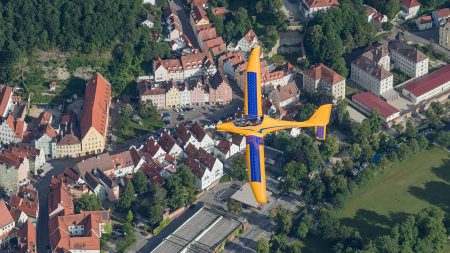
Extreme weather events such as storms and drought as well as pest infestation weaken the vegetation alongside railways and roads, which can endanger operational safety. The Deutsche Bahn invests up to 125 million euros each year in the inspection and management of the tree vegetation along the railway infrastructure. Elektra Solar and RealityMaps have developed a new geodata acquisition system that significantly improves existing technologies for assessing and monitoring the health condition of the vegetation alongside railways. It consists of an environmentally friendly, solar-electric-powered ultralight aircraft, a multi-sensor 3D camera system and AI-based data evaluation. This unique system makes it possible to record aerial images, 3D elevation, thermal imagery and multispectral data simultaneously in one flight. Productivity is much higher, while providing a similar spatial resolution to UAVs.
Benefits:
Extremely efficient and environmentally friendly collection of spatial data from the air
Detailed recording of the health condition of the vegetation with a multi-sensor 3D camera system
Digitisation of up to 400 km of railways per day
Also suitable for road management and monitoring of construction measures (BIM)
Calculation of virtual 3D models and digital twins with a level of detail that has never been achieved before
DLTEO – the one-stop shop for the earth observation data market
The Earth Observation (EO) data product market will grow exponentially to become another full-fledged commodity market, yet there are two key elements that are currently missing from it:
Low friction and barriers for users via easy-to-use interfaces that allow players in the industry chain to bypass specialists
Customisability of data processing pipelines to allow for easy fusion of different data sources to EO data, to help define new correlations and consolidate all previously fragmented value chain activities in one platform
Meanwhile, many companies have a high demand for EO data products that is either partially or fully unmet due to the difficulties of integrating into the current market. DLTEO GmbH is developing a decentralised, transparent, scalable and fair new market era. DLTEO is an AI-run, peer-to-peer and crowd-sourced EO data mining and trading „one-stop shop“. DLTEO has created a new serverless, scalable, decentralised fusion-computing paradigm enabling customised EO digital assets to be processed and traded transparently yet privately in quasi-real time at any point in the data’s lifecycle.
Benefits:
One-stop shop for all market levels (Downstream, Midstream, Upstream)
Buy/sell/process data locally or on our distributed network
Customers stay in control of their data! The data is always encrypted, safe from third parties
Fully open-source and externally auditable tech stack
Unique decentralised architecture built on cutting-edge technology
Support for complex data and processing licence agreements (subscriptions, quality guarantees, etc.)
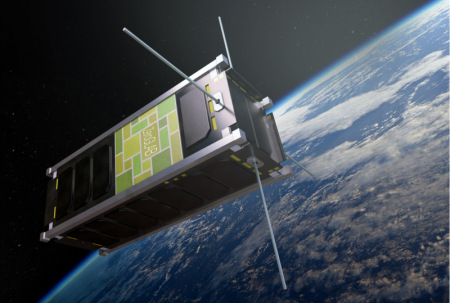
Micro G Scope (MGS) is an innovative approach to the problem of biological testing in space, using an innovative fluorescence contact CMOS microscope and special growing chamber in a CubeSat. The technical requirements for space biology are enormous, and the effort to reduce the cost while maintaining precision and safety is huge. The project’s goal is to solve the problem of the accessibility (and cost) of biological tests in space by providing not only an instrument for biological experiments, but a whole service for pharma and bio-tech companies that will include: experiment design, cell preparation microscale fluorescence microscope, and calibration chamber. In addition, the microlaboratory could be easily modified to accommodate alternative experiments such as seed and spore germination, embryology studies, and the production of nutrients in space, among others. Micro G Scope‘s first design is aimed at testing cancer drugs in space to extract information on whether these drugs work under reduced gravity conditions. The project is currently at SRR level (System Requirements Review) through PDR (Preliminary Design Review).
Benefits:
New cell chamber and microscope design for biological experiments in space based on a lensless design with no moving parts and the size of a credit card
Reduced cost and time to perform the experiments
New full service for the pharma industry where experiment preparation, mission accomplishments, and data review are transparent for the client
ALReCo – Orbit Recycling’s new composite material for sustainable Moon exploration
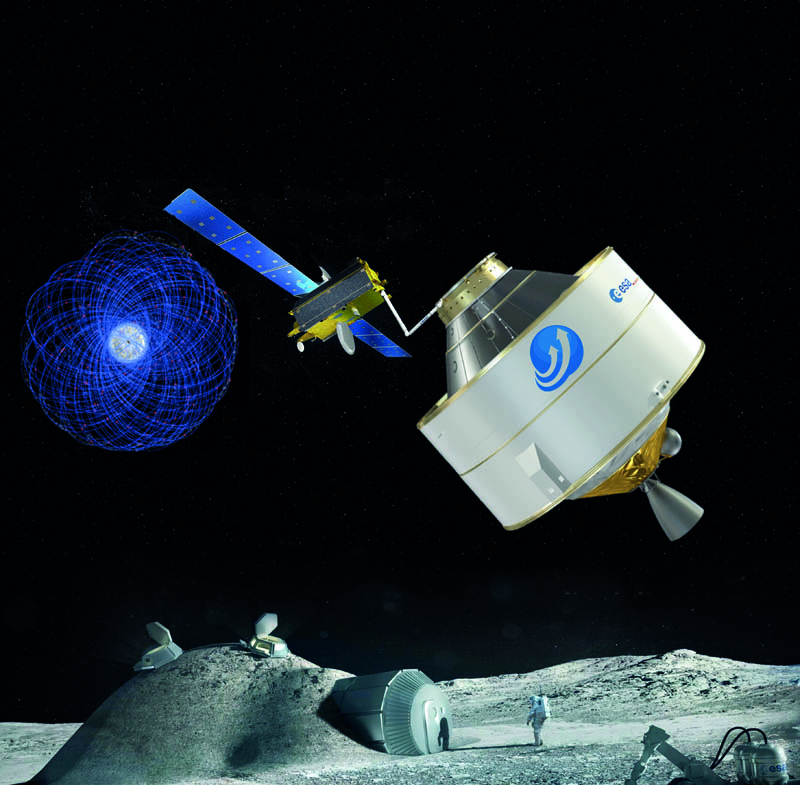
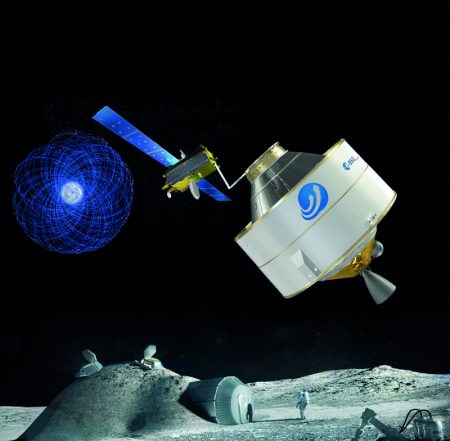
Humans are heading back to the Moon. Artemis and the Lunar Gateway programme are on their way and the next step will be the lunar ground station. But one major problem for a sustainable outpost on the Moon remains: Moon dust (regolith) doesn’t have the right material properties to either store energy efficiently or to be an ideal construction material. The result would be to transport massive quantities of material from the Earth. Orbit Recycling has developed a new composite: ALReCo. Using a unique method, regolith is mixed with material from space debris to enhance its physical properties. ALReCo shows improved thermal capacity and conductivity in order to store energy much better. ALReCo is better suited to construction elements and the integration of aluminium structures, and flanges with regolith parts could become a modular framework for the upcoming Moon base. By turning waste into valuable material, ALReCo reduces not only the amount of space debris but the amount of material that needs to be transported from Earth as well.
Benefits:
ALReCo enables a self-paying space debris recycling concept
ALReCo reduces material transportation during the construction of the lunar ground station
ALReCo offers flexible use cases, from construction elements to energy storage solutions
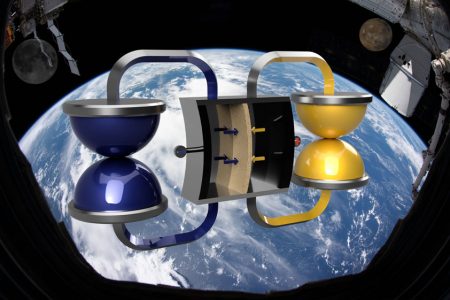
Energy security plays a major role for satellites and space stations due to their isolated places of operation. Since solar energy is often used to operate these spacecraft, reliable energy storage systems are crucial to compensate for fluctuations in direct solar radiation. These storage systems need to have a very long service life as well as a high operational safety in order to sustainably reduce resource-intensive replacement missions as well as hazards for humans and equipment. However, the battery systems currently used in spacecraft have significant deficits in these areas. That’s why, with »SpaceFlow«, a new energy storage concept for space applications is being presented, which completely fulfils the requirements. »SpaceFlow« is an incomparably long-lasting, charge-cycle-stable, safe and reliable redox flow battery system based on porous metal foam electrodes and zinc-polyiodide electrolytes. The innovative design allows the pressure-stable yet flexible battery cells to be integrated directly into the spacecraft support structures, so that, in addition to energy storage, other functions such as module stiffening or thermal management can be realised with an efficient use of space.
Benefits:
Very long service life and theoretically unlimited cycle stability
Particularly high operational safety and environmentally neutral cell chemistry
Very efficient use of space with multiple applications
ERMES – Extensive road monitoring and early-warning system
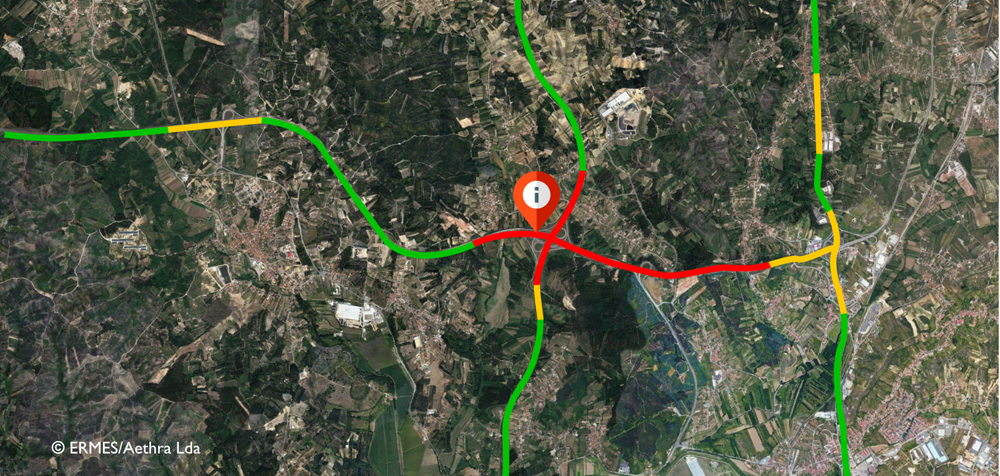
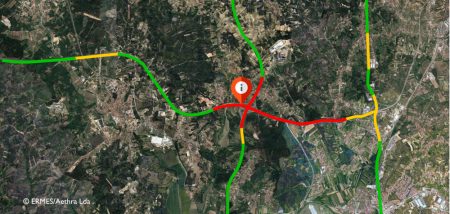
Slope stability and ground subsidence along roads and railway tracks are currently monitored using inclinometers and land surveying. These measures lead to substantial logistical challenges and increased costs. THEIA has developed ERMES (Extensive Road Monitoring Early Warning System) to perform large-scale road infrastructure monitoring through satellite data. The system uses multiple advanced remote sensing methodologies to track ground deformation and monitor slope stability and ground subsidence throughout road and railway networks. Using high-frequency remote sensing data, ERMES can determine the speed of deformation and set up an early-warning system for structural health monitoring. This enables efficient, preventive maintenance strategies to be implemented and measures to be optimised to minimise risk.
Benefits:
Enables regular monitoring of large infrastructure using satellite data
Optimisation of maintenance costs and operations for road and rail infrastructure
Reduction of critical outages and increase in security
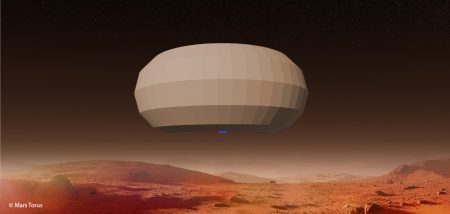
Future robotic and manned Mars missions require high-resolution images of large sections of the planet. The current geographic coverage is achieved either from great height (400 km), or by rovers directly on the surface. Mars Torus is a unique craft, able to produce high-definition images at a height of 2 km while navigating widely over the planet’s surface. Thanks to its structure and a contained vacuum, Torus achieves lift in the thin Martian atmosphere. It thus has a very low energy demand. The energy required for forward momentum and further functions can be generated by solar panels. Mars Torus will have the mobility to relocate in the atmosphere to predefined locations, helping to map locations of interest and search for traces of water and methane. To allow Mars Torus to navigate precisely and communicate with Earth, it will have its own supporting satellite navigation system via a network of pre-positioned cubesats.
Benefits:
High-definition images of the Mars surface
Autonomous waypoint navigation around Mars
Chemical sampling of the Mars atmosphere
Reduction in the risk to future robotic and human missions
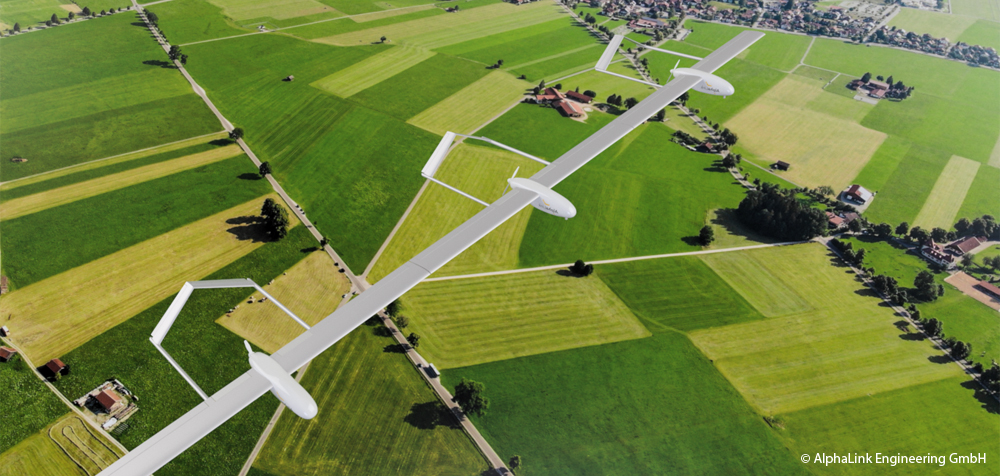
The civil UAV market with a worldwide market volume of USD 6.56 billion in 2018 is expected to grow to USD 43 billion by 2024*. Market growth in the coming years will be driven by the large number of new commercial applications, in particular by the use of unmanned stratospheric flight systems for telecommunications and Earth observation services. For perennial operation at high altitudes, these aircraft require an extremely large wingspan with the lowest possible structural weight. When flying in the troposphere, conventional aircraft configurations face a particular risk that greater turbulences could lead to cracks and fractures in the aircraft structure. The Berlin-based company AlphaLink Engineering GmbH is currently developing a compound aircraft that can solve this structural-mechanical lightweight construction dilemma by connecting multiple aircraft modules at their wingtips through mechanical joints. After intensive research at Technische Universität Berlin, the patented technology is now being tested by AlphaLink in the form of test vehicles and flight trials. The compound aircraft is the first electrically powered stratospheric aircraft that achieves both long operating times and high payloads.
* SESAR, European ATM Master Plan, Roadmap for the safe integration of drones into all classes of airspace, 2018
Benefits:
Secure, unmanned operation for low-cost Internet access in remote areas
First flying platform with a modular approach
Technology is fully scalable as a complement and alternative to satellite systems
Year-round operation possible just powered by solar energy
Can be used as “flying camera” or “mobile antenna”
Artificial Intelligence for and from Satellite Internet Constellations
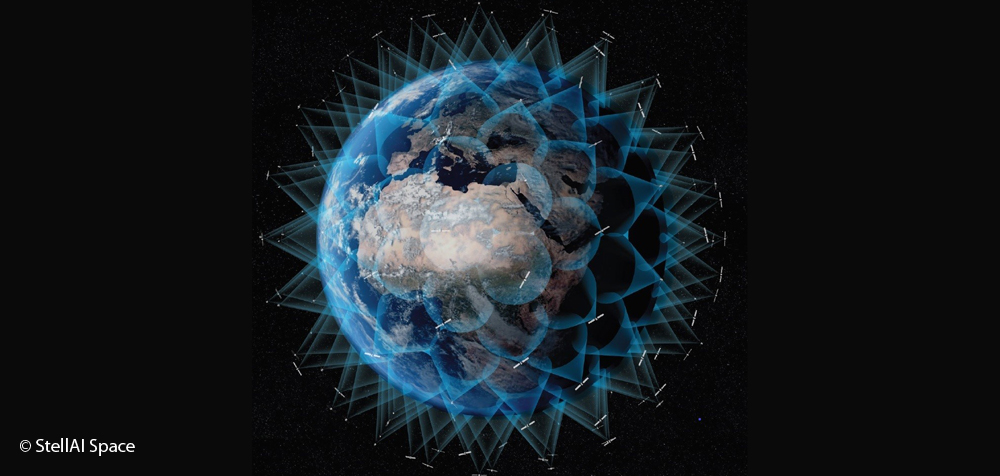
The main stakeholder in the commercial space industry are looking for ways to deploy, operate and maintain large satellite constellations at low cost. Projections indicate that in the next decade, the number of satellites in Earth‘s orbit will increase from a few thousand to hundreds of thousands. Managing such a large number of satellites manually with conventional control centres and workers will be very difficult and expensive, which is why operators and space agencies are looking for ways to automate their constellation management. This is where artificial intelligence (AI) and machine learning algorithms can provide support. Avoiding collisions with space debris, setting up and maintaining communication networks, monitoring the condition of the satellites and their operating routines are just some of the tasks that StellAI Space intends to solve with AI. The company‘s solution will use data from hundreds of satellites forming existing constellations in orbit as input for machine learning algorithms. The resulting model will be used to build a scale-up simulation with hundreds of thousands of satellites and leverage AI to achieve constellation autonomy.
Fraunhofer IISB is developing a novel technology for ultra-high-temperature resistant protective coatings for space applications. The HOSSA project is based on the institute’s research work to apply ceramic protective coatings to fibre-reinforced composites using powder coating technology. The aim is to make the advantages of fibre-reinforced composite components, such as high elongation at fracture, high cracking resistance and dynamic load capacity, available for new applications by increasing heat and oxidation resistance as well as increased mechanical abrasion resistance. The patented technology offers a considerable cost advantage over conventional coating processes and is also suitable for component repair. With HOSSA, the efficiency of propulsion systems and the exposure time for re-entry vehicles can be increased. These protective coatings can also be applied for power units of aircraft and helicopters as well as gas turbines.
Benefits:
Highly tuneable coating technology to achieve different coating properties
Cost-effective and highly flexible in terms of part geometry and size
Enables the application of fibre-reinforced composites in new applications
Higher combustion temperatures and thus increased efficiency of rocket engines and power units