Flow Front Detection with Fibre-Optic Sensors in the Rotating Infusion
Process for CFRP (carbon-Rber-reinforced polymer) Components
In the boosters of the Ariane-6 launch vehicle MT Aerospace AG of Augsburg, Germany, is producing some of the space industry’s largest CFRP components. Measuring around 12 metres long and 3.4 metres in diameter, these parts are manufactured using a vacuum infusion process in which dry carbon fibres are wound around a form and then submerged in resin. Intelligent sensors are needed to monitor the flow front of the resin as it is introduced and optimise the overall process. For this purpose, MT Aerospace AG is now working with Fraunhofer LBF on incorporating glass fibre sensors into its components during the winding phase. During infusion, each component has to be turned slowly in an oven. This delicate step is where the sensors monitor the distribution of the resin.
Benefits:
Digitalised manufacturing optimises the process while reducing costs
Visualisation of previously hidden processes and corresponding digital controls provide for increased process stability
Information gained from sensors makes it possible to automate the Aow of resin and ensure quality and repeatability
Process data also improves control and accelerates ramp-up to serial production, which makes the company more competitive
Fraunhofer LBF Darmstadt, Germony Martin Lehmann www.lbf.fraunhofer.de martin.lehmann@lbf.fraunhofer.de
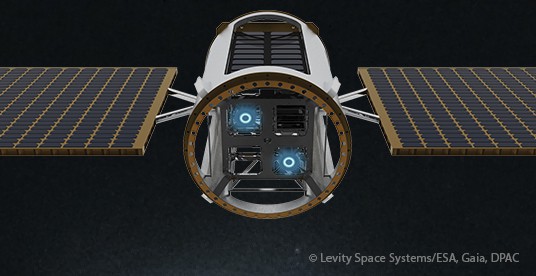
The launch capacity of launch providers is not always sufficient to meet the increasing demands on the flexibility of microsatellite operators. Levity Space Systems is developing an electrically propelled microlauncher kickstage, to transport small satellites into higher orbits beyond the microlauncher capabilities. The additional stage establishes a new alternative for satellite operators, by expanding mission capabilities and reducing launch costs, while increasing the launch performance of the microlauncher. The goal is to provide satellite operators with the opportunity to use microlaunchers as a viable alternative to conventional rockets, as they are able to reach low Earth and lunar orbits, reducing launch times, as well as reliable satellite constellation maintenance by specifically replacing defective satellites.
Benefits:
Transport of small satellites into higher orbits (access to lunar orbit using microlaunchers)
Reduction of the launch interval from 24 to 3 months
Reduction of launch- and opportunity costs
Deployment and maintenance of microsatellite constellations
Avoidance of secondary payload restrictions
Increasing number of possible satellite concepts and applications
Golden Fleece – In-Space Nanometal 2D Printing Demonstration
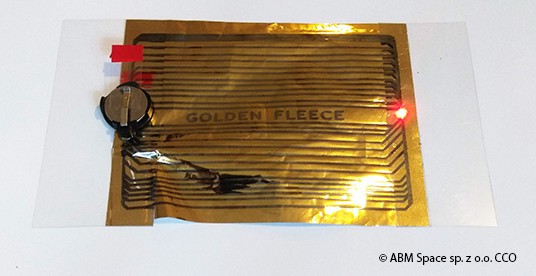
Golden Fleece is an intelligent solar sail concept used for spacecraft propulsion. ABM Space and AMEPOX Microelectronics developed a production process with a 2D-printing technology, allowing the solar sail to be covered with in-situ nanometal ink to place electronic circuits on the sail substrate. Nanometal has outstanding and diversified mechanical, thermal and electrical properties which can be used for various applications in the field of space materials. The development of this 2D-printing method will facilitate in-orbit production and utilisation of metals gained in the future, particularly in-situ from the Moon and asteroids. The technology enables flexible production in space, spare parts production from lightweight material and mass production from future in-situ resources.
Benefits
Flexibility of electronics production in space
Flexibility of production of lightweight structures in space
Nanosilver as a biocide allows sterile structures and reductions in cleanroom costs
Shapecomm – Shaping the Future of Satellite Communication
Current communication systems are experiencing great technical changes but do not fully reach the theoretical data rate limits. Satellite communication, in particular, requires flexibility and higher transmission rates to cope with current demands, e.g., for inflight entertainment systems or high throughput satellites. Shapecomm showcased the innovative technology of “Probabilistic Amplitude Shaping” (PAS) and “Distribution Matching” (DM), which achieved a 2.5-fold rate increase in an optical transmission experiment over the Atlantic Ocean conducted by Facebook and Nokia Bell Labs. Based on the patented technology, the company’s objective is to develop a transceiver architecture building upon the DVB-S2X standard, which could support new standardization endeavours, possibly culminating in DVB-S3.
Benefits:
Increase the data rate limits of current communication systems, e.g. satellite communication links
Efficient use of existing resources (e.g. bandwidth), helping to serve and accommodate more users and provide a better experience to end users
Important enabler and pioneer for future applications that require high data rates
Transceiver modems can be designed and produced more flexibly and with lower costs
Economically efficient provision of reliable connections and high data rates in remote areas
SUMSENS – Structure-Borne Ultrasonic Multi-Hop Sensor Network for the Temperature Monitoring of Satellites
The mechanical and thermal integrity of spacecraft will be crucial for future space missions lasting months, years, or even longer. Traditionally, wired sensors are used to measure all relevant parameters. SUMSENS offers the integration of a holistic wireless sensor network using the satellite structure itself for communication, in order to provide in-situ monitoring of the mechanical and thermal subsystem status. The SUMSENS sensor network consists of smart temperature sensor nodes, communicating among themselves via structure-borne ultrasonic waves. The core of each sensor node is a microcontroller platform providing all required data operations. SUMSENS integrates Augmented Reality (AR) to support visual system integration, monitoring and maintenance. The technology can be transferred from space to ground transportation.
Benefits:
Wireless sensor network instead of heavy, space-consuming network infrastructure consisting of cable clutter
Cost reduction due to flexible installation, easy expandability, low energy consumption and reduction of communication traffic
Multifunctional lightweight structures for satellites
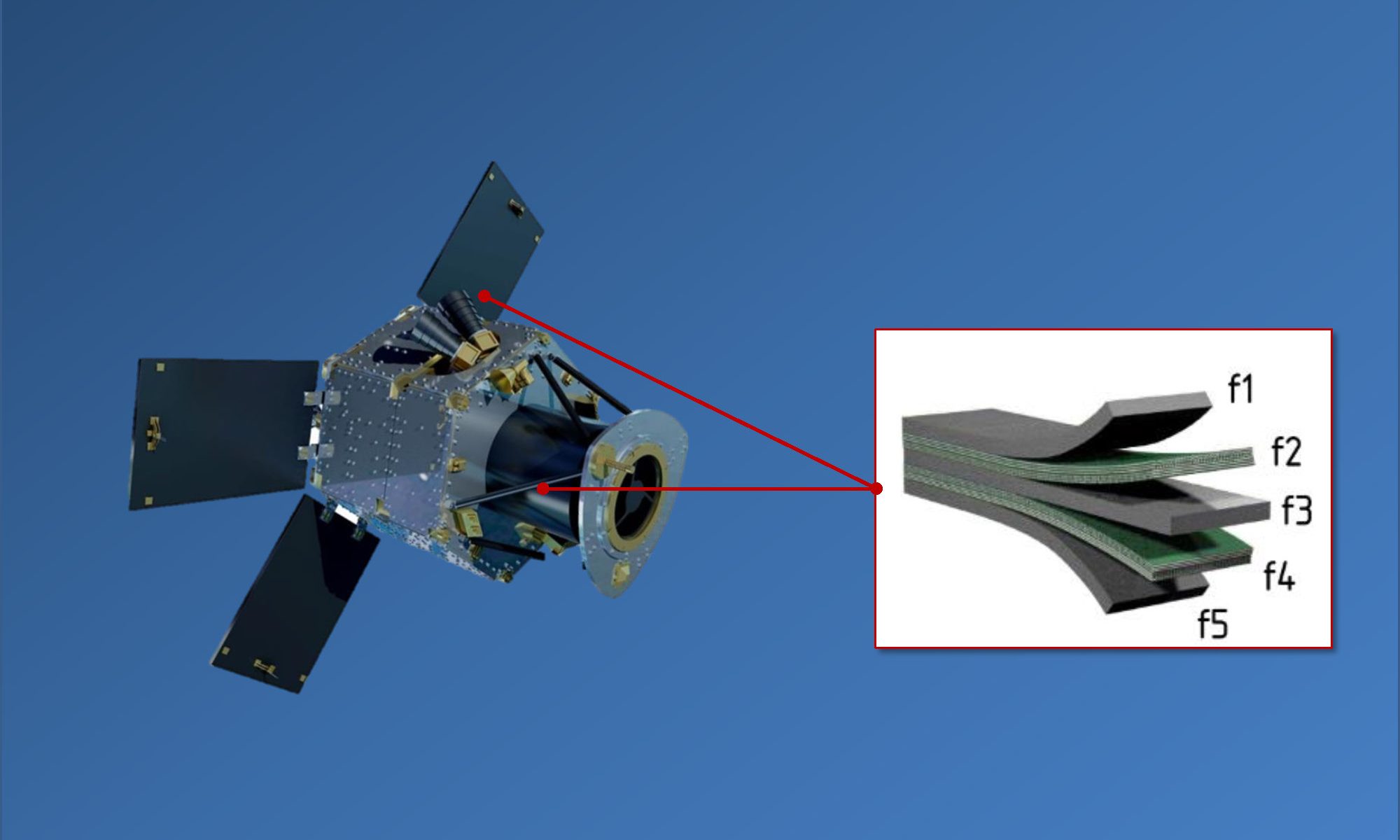
Conventional satellite design separately considers functional, structural and protective requirements. Subsystems are not integrated into the primary structure, but applied at a later production stage.
Project aim: disruptive innovation in satellite design
Integration of functions into load-carrying structural parts (communication, thermal management, vibration control, diagnosis)
Concurrent optimisation of structural and functional properties with respect to mass and production processes
Validation by a demonstrator
Fraunhofer Institute for Structural Durability and System Reliability LBF Dr Dirk Mayer dirk.mayer@lbf.fraunholer.de