Versatile approach for cloudless optical satellite data
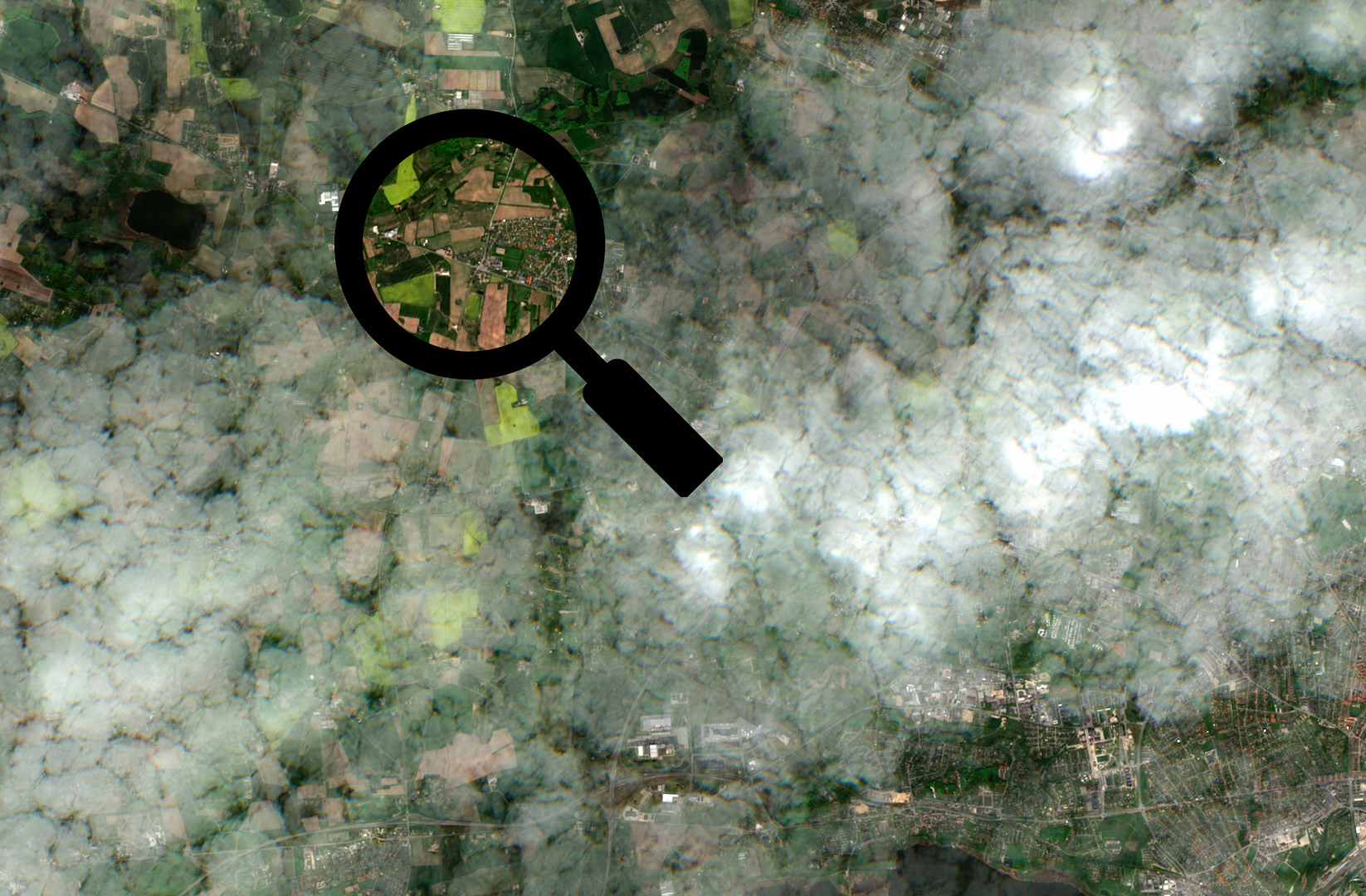
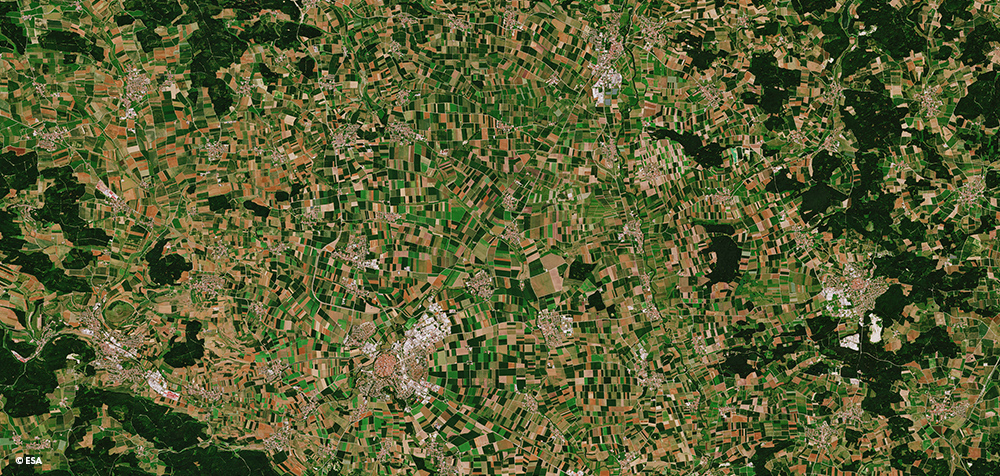
In Earth observation, clouds and shadows are the most limiting factors for consistent and up-to-date imagery. While optical satellite data can be retrieved daily, actionable insights are much rarer. To overcome this lack of cloudless data, large identical satellite constellations are required. However, this only improves one’s chance of actionable insights while ignoring the root cause. Less than perfect data is still not utilised in this process and is often even difficult to identify. ClearSky Vision addresses these problems by integrating data from various missions (Sentinel-1, Sentinel-2, Landsat 8, and more) while using a novel neural network to predict urban and landscape changes underneath the cloud cover. This data fusion process is repeatable on different satellites. This allows for more consistent and frequent retrieval of multi-spectral cloudless satellite imagery and indices that are crucial to improved time-series analysis and anomaly detection. Satellites with different instruments and revisit speeds can be utilised in synergy, thereby combining the best features of different satellites.
Benefits:
The most up-to-date cloudless optical imagery (updated daily)
Enables utilisation of multiple different satellites for the same application
Enables affordable continuous monitoring for large areas
Highly versatile and efficient data fusion process
DigiFarm – detecting the world’s most accurate field boundaries to power precision agriculture
All precision agriculture services start with accurate field boundaries and seeded acres. Unfortunately, the problem is that one is making critical decisions based on inaccurate data, cadastral field boundary data, which is affecting the entire agricultural value chain. DigiFarm has spent the last two years developing a deep-resolution algorithm for Sentinel-2 imagery to increase image resolution by 10x from 10m to 1m, coupled with a deep neural network model to automatically detect field boundaries on a large scale. DigiFarm has delineated over 15 million ha across the world and has achieved an average (IoU) accuracy of above 0.96, which represents up to 20% greater accuracy than existing cadastral map data. DigiFarm delivers four key models to B2B and B2G clients through various API endpoints, including: automatic field boundary detection (and seeded acres), deep resolution of Sentinel-2 at 1m resolution on demand, automatic delineation of in-field productivity zones and crop classification, the ability to automatically detect field boundaries (seeded acres) using deep neural network models and super-high-resolution satellite imagery.
Benefits:
Deep neural network model to delineate field boundaries and seeded acres
Deep neural network model for the deep resolution of Sentinel-2 (10x) to 1m per pixel resolution, achieving sub-metre georeference accuracy
Packaged products in APIs with simple integration and setup
Easy SaaS pricing for B2B and B2G clients starting at EUR 0.03 per hectare/year
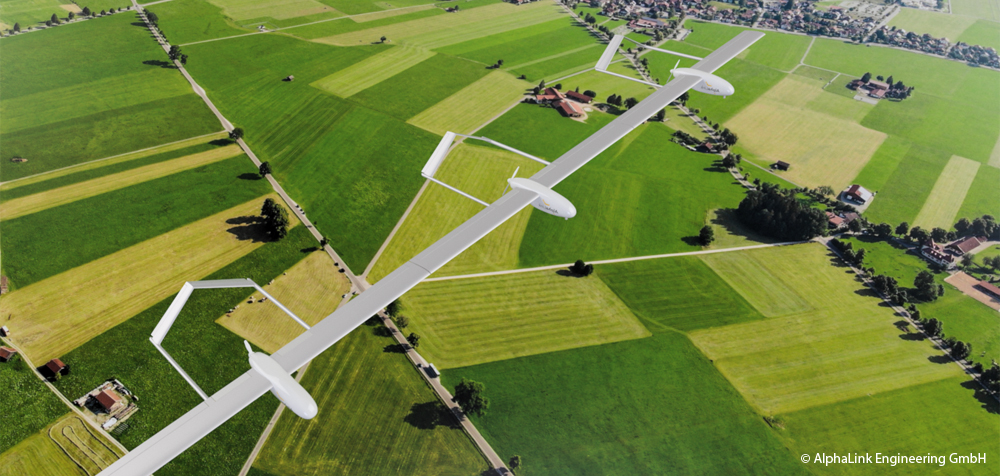
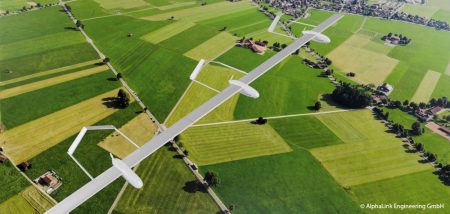
The civil UAV market with a worldwide market volume of USD 6.56 billion in 2018 is expected to grow to USD 43 billion by 2024*. Market growth in the coming years will be driven by the large number of new commercial applications, in particular by the use of unmanned stratospheric flight systems for telecommunications and Earth observation services. For perennial operation at high altitudes, these aircraft require an extremely large wingspan with the lowest possible structural weight. When flying in the troposphere, conventional aircraft configurations face a particular risk that greater turbulences could lead to cracks and fractures in the aircraft structure. The Berlin-based company AlphaLink Engineering GmbH is currently developing a compound aircraft that can solve this structural-mechanical lightweight construction dilemma by connecting multiple aircraft modules at their wingtips through mechanical joints. After intensive research at Technische Universität Berlin, the patented technology is now being tested by AlphaLink in the form of test vehicles and flight trials. The compound aircraft is the first electrically powered stratospheric aircraft that achieves both long operating times and high payloads.
* SESAR, European ATM Master Plan, Roadmap for the safe integration of drones into all classes of airspace, 2018
Benefits:
Secure, unmanned operation for low-cost Internet access in remote areas
First flying platform with a modular approach
Technology is fully scalable as a complement and alternative to satellite systems
Year-round operation possible just powered by solar energy
Can be used as “flying camera” or “mobile antenna”
GNSS common-view – Time and frequency synchronisation for industry
Time synchronisation is a basic requirement for operating important infrastructures in almost all industrial sectors worldwide, such as the energy, telecommunications, transport and financial sectors. The high demands on the accuracy of time measurement, which is currently in the single-digit nanosecond range, are an essential driver of technology and innovation to take time measurement into ever new dimensions. Time synchronisation is traditionally achieved via cable protocols with their own network timing. The use of such dedicated networks is not always possible for financial or logistical reasons, such as for systems operating on different continents (finance), in densely populated urban areas (5G or IoT) or for highly decentralised systems (blockchain). Melior Systems GmbH is working on a cost-effective, global system solution for highly accurate time synchronisation based on the atomic clocks of navigation satellites (GNSS) in combination with exact time comparisons using what is known as the common-view method. The system solution is offered to infrastructure operators and other customers as a software licence in conjunction with support services.
Benefits:
Time and frequency synchronisation based on GNSS with 1-digit nanosecond accuracy
Cost-effective deployment independent of the link distance to synchronise
Reduced costs of infrastructure in urban areas and improved indoor GNSS reception
Tikal – Remote assessment of remote traffic routes
Only 20% of the world’s road network is paved, making it particularly vulnerable to environmental, weather and vehicle-related damage. The monitoring of unpaved roads is of high relevance as they are also used to transport people and goods. There are currently no IT-based methods that can be used to continuously record and analyse the condition of the road over a wide area. Within the framework of the Tikal project, BAREWAYS GmbH is developing a software system that can determine the current and future road condition by means of pattern recognition, even from inhomogeneous and incomplete data sets. For this purpose, a wide variety of data sources such as weather forecasts, maps, satellite images, and vehicle sensors are aggregated, calibrated and analysed with the help of Artificial Intelligence (AI). This current road condition information is made available to the vehicle navigation system together with other criteria for route planning and optimisation such as vehicle type, fragility of the load or safety needs of the driver.
Benefits:
Prediction of road conditions in rural areas that are not covered today
The fusion of vehicle sensors, satellite imagery, and weather forecasts
Flexible routing to account for individual vehicle capabilities
Applicable to other transport lines such as railways and power lines
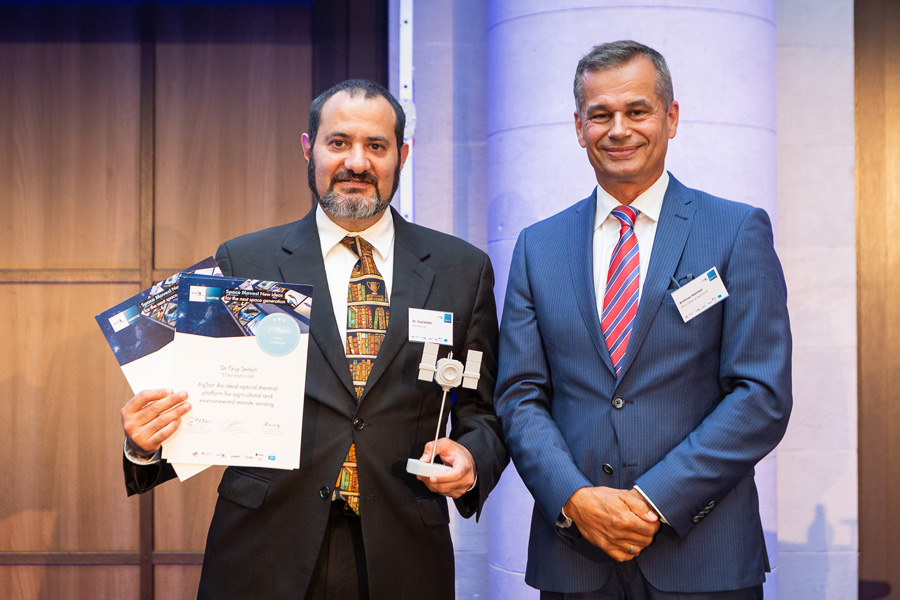
AgSat – An Ideal Optical-Thermal Platform for Agricultural and Environmental Remote Sensing
The growing human population, associated challenges related to climate change, and the insufficiency of existing terrestrial sensing systems require new sources of Earth observation (EO) data. Critical parameters like non-photosynthetic vegetation (NPV) and evapotranspiration (ET) are not properly estimated by existing operational EO systems. NPV is important for estimating fire risk, tillage intensity, and the risk of soil erosion due to water and wind. ET is important for agricultural production and water usage. AgSat will offer an advanced multispectral satellite concept that will not only measure those parameters, but also include on-board artificial intelligence and data processing to minimise data downloads while using laser-based systems for more efficient data transmission. AgSat will deliver custom, need-driven, cloud-free data products directly to stakeholders within minutes of acquisition. Science data will be available to end users under an open data policy.
Benefits:
Data continuity with Sentinel-2/Landsat missions
Open data for science products
On-board anomalous event detection (fires, floods) and data product creation, including downlinking to end users
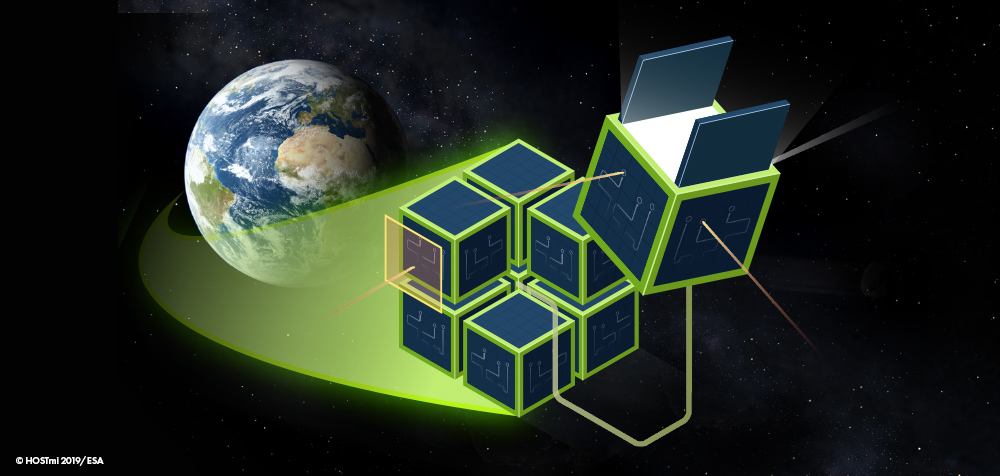
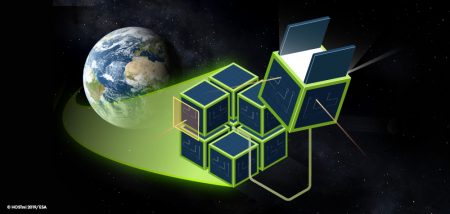
The traditional space sector does not offer fast, simple, low-cost access to space for the commercially driven new space economy. HOSTmi is the first neutral digital B2B platform for payload owners and space mission providers that matches the growing commercial and scientific demand. This standardised online platform offers efficient, user-friendly, and global mediation of flight options aboard various space-based systems, from suborbital vehicles to deep space platforms. Payload owners receive real-time product and service information, along with the ability to search for potential hosting opportunities for their payload. Besides being available to payload owners for an annual subscription fee, HOSTmi operates on a contract- and success-based commission model for space mission providers. It is thus digitising the global market for space payloads in a scalable fashion.
Benefits:
Digital one-stop-shop bundles services such as technical support, financing, and insurance
Efficient automated processes significantly reduce time and cost requirements for payload owners
Space mission providers will be able to sell their services and unused capacity, which will reduce the direct cost of sales and customer acquisition based on an automated influx of prospects
Fosters the transition from conservative value chains to a modern, customer-oriented value network
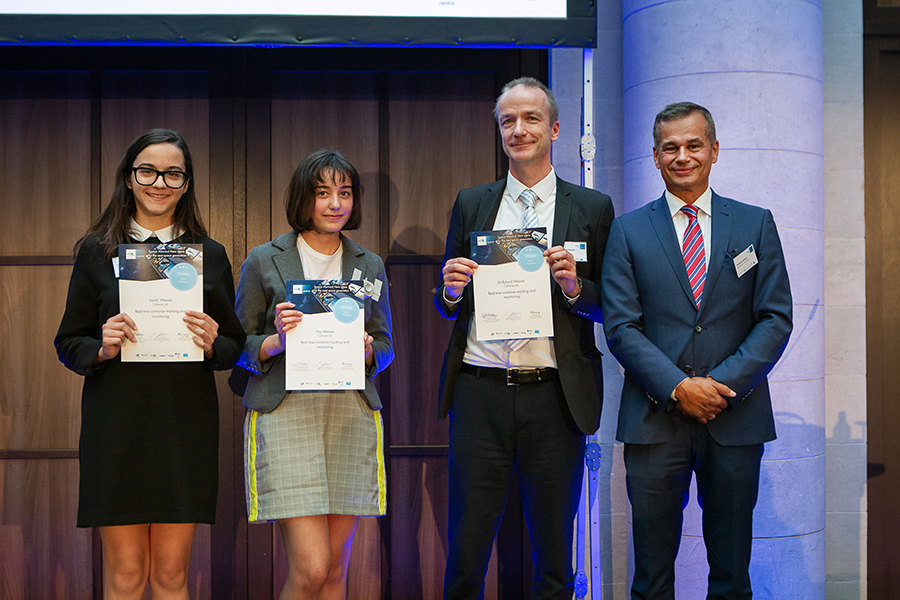
Modern transport and logistics require real-time tracking and monitoring of shipping containers worldwide. Many applications on the market track only the location of the vessel on which a container is transported – not the container itself. Therefore, the tracking signal is lost when the container is transferred between ships, trains, trucks and aircraft, or if it happens to be lost at sea. Callwise Ltd. addresses these issues using an innovative combination of satellite communication and a 5G LoRaWAN (Low Range Wide Area Network) IoT solution. This solution enables real-time tracking and monitoring of individual shipping containers from start to finish during multimodal transport. The concept is based on a novel architecture in which satellite and cellular tracking is combined with LoRaWAN tracking and monitoring of individual shipping containers. Callwise Ltd. is targeting logistics and shipping companies that can offer this end-to-end solution to customers as a value-added service in their product portfolios. Furthermore, the system is able to generate alerts for a wide range of events (unauthorised door opening, deviation from a predefined route, changes in container temperature, etc.) and also track down containers lost at sea.
Benefits:
Real-time location information on shipping containers from start to finish
Ability to monitor several parameters inside containers (e.g. temperature, air pressure, air moisture)
SPACE IC produces highly integrated and versatile microchips for efficient power conversion. In satellite payloads, these chips help solve the power interface problem which electronic modules face. Individual power interfaces limit the reusability of these modules and make power distribution systems both complicated and inflexible. This is where the Standard lntermediate Power Bus Interface comes into play, which SPACE IC is going to define along with experts in power management. A standard interface of this kind will aid satellite payload manufacturers in increasing efficiency and Aexibility of power distribution while reducing complexity and costs.
Benefits:
Flexible, efficient power distribution
Simplified development and production
lmproved reusability and risk reduction
Multiple cost-reduction effects, from reduced weight and effort to mass production
SPACE IC GmbH Hanover, Germany Volodymyr Burkhay www.space-ic.com info@space-ic.com
MSP: Advanced Modular Production of Microsatellites
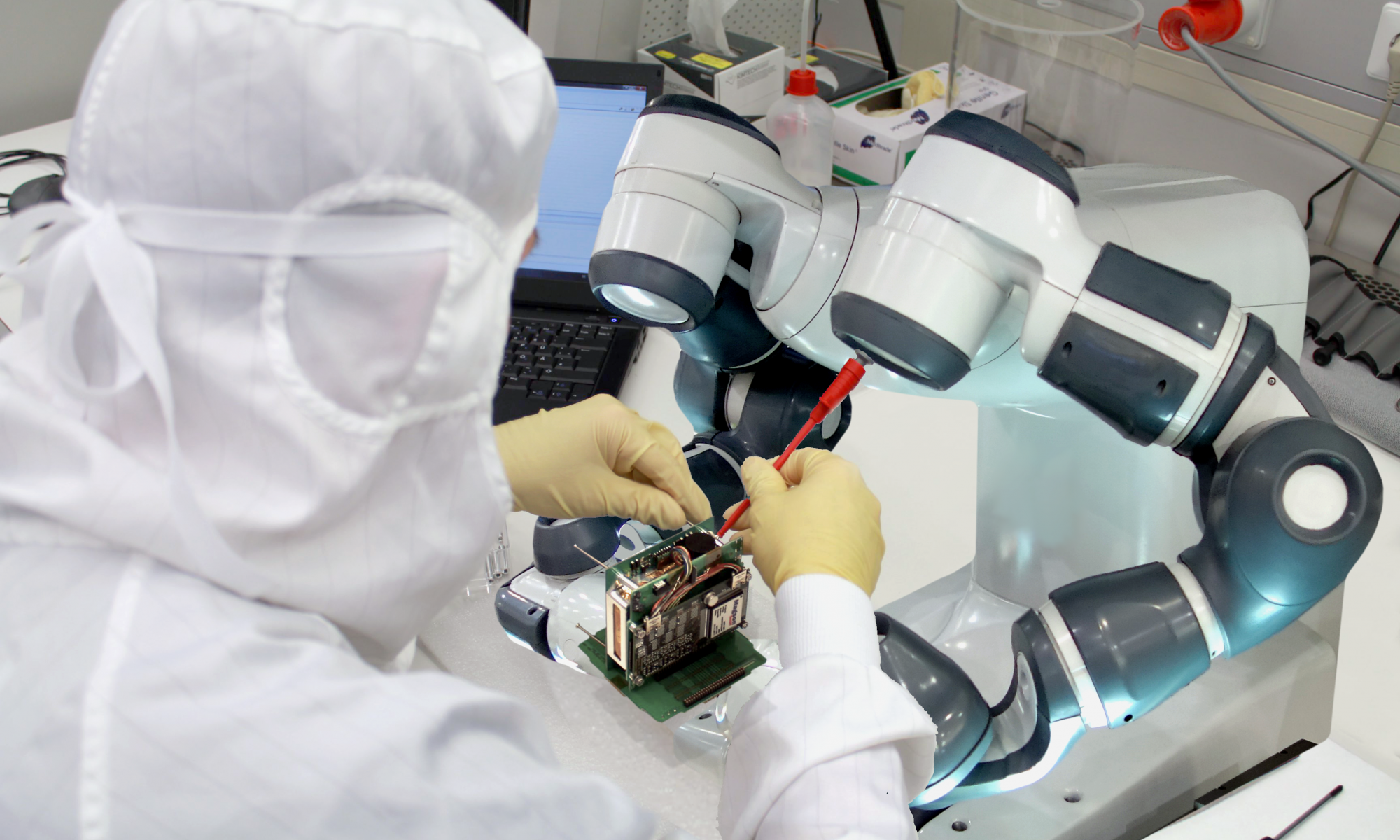
To keep up with the emerging requirements of mass production, mega-constellations and formations of microsatellites one needs innovative lest concepts and production processes. Modern manufacturing techniques from the realm of lndustry 4.0 can open the door to significant productivity gains in high-volume satellite production. The Zentrum für Telematik e.V. (Würzburg) is working on transferring new methods and tools for satellite production into the space sector. The submitted idea is specifically geared towards humanrobot collaboration based on the use of a lightweight robot.
Benefits:
Integrated testing and production systems increase lot sizes and quality
Modularisation and standardisation in electronic production reduces overall system complexity, which also simplifies the production process
Testing based on smart components reduces production costs
Zentrum für Telematik (ZfT) Würzburg, Germany Prof Dr Klaus Schilling www.telematik-zentrum.de info@telemotik-zentrum.de