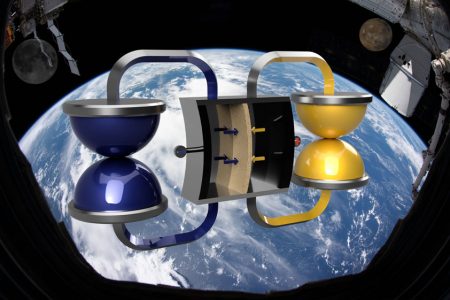
Energy security plays a major role for satellites and space stations due to their isolated places of operation. Since solar energy is often used to operate these spacecraft, reliable energy storage systems are crucial to compensate for fluctuations in direct solar radiation. These storage systems need to have a very long service life as well as a high operational safety in order to sustainably reduce resource-intensive replacement missions as well as hazards for humans and equipment. However, the battery systems currently used in spacecraft have significant deficits in these areas. That’s why, with »SpaceFlow«, a new energy storage concept for space applications is being presented, which completely fulfils the requirements. »SpaceFlow« is an incomparably long-lasting, charge-cycle-stable, safe and reliable redox flow battery system based on porous metal foam electrodes and zinc-polyiodide electrolytes. The innovative design allows the pressure-stable yet flexible battery cells to be integrated directly into the spacecraft support structures, so that, in addition to energy storage, other functions such as module stiffening or thermal management can be realised with an efficient use of space.
Benefits:
Very long service life and theoretically unlimited cycle stability
Particularly high operational safety and environmentally neutral cell chemistry
Very efficient use of space with multiple applications
TOMOPLEX – A sensor film to monitor structures during flight and under a load
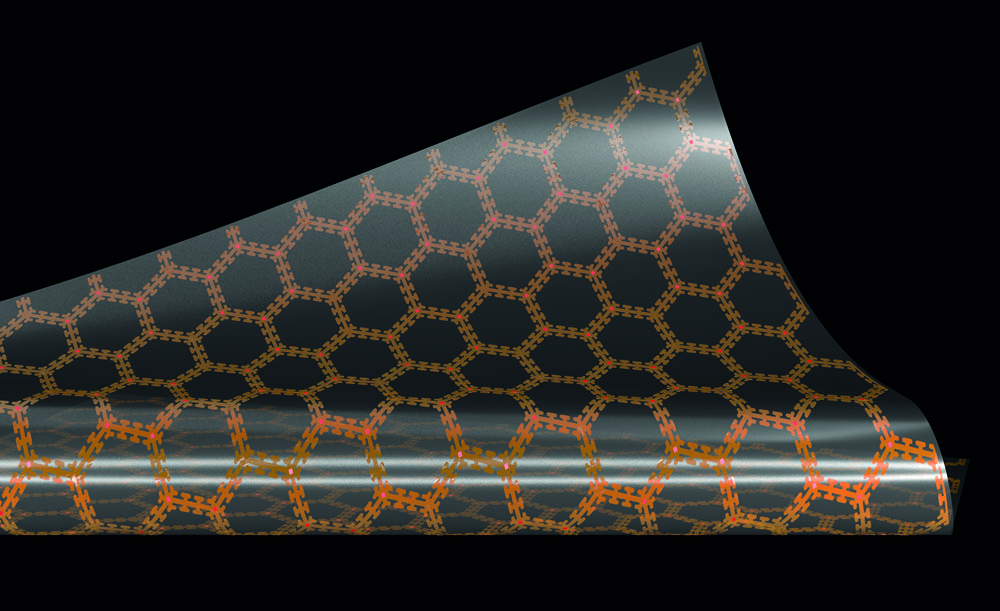
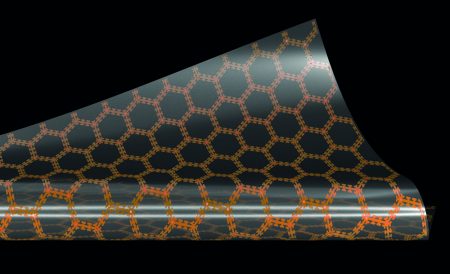
Only reusability ensures cost-effectiveness in order to be able to operate the space sector in line with “New Space”. However, the possible saving in costs is limited by maintenance requirements. Some faults also only occur under a load, but remain hidden during inspections without a load. One example of this is break lines, which fit together perfectly in an unloaded state. A comprehensive installation of measuring probes to monitor structures during flight is not currently feasible, as the conventional measuring technology required for this is too large and heavy. The problem of needing to monitor structures in real time has now been resolved by creating a version of the sensor as a sensor film that can be applied to the surfaces of the structures undergoing monitoring. It is possible to use alternative measuring procedures and, in particular, electric impedance tomography (EIT) here, which has been uncommon in the aerospace sector up to now. The sensor film acts as the circuit carrier for a wireless sensor network. The sensor film is space-saving and flexible, and can also be used in hard-to-reach areas.
Benefits:
Continuous real-time monitoring under a load during flight
Increase in the likelihood of reusability
Reduced costs due to optimised maintenance with the aid of innovative analysis data
QuVeKS – quantum processors for encrypted communication with satellites
Novel quantum technologies of the 21st century promise unconditionally secure communication, exponentially larger computational power as well as compact and more precise sensors. Many of the quantum systems under investigation, however, are application-specific and not compatible with each other. Within the QuVeKS project, a universal quantum processor will be developed at the Friedrich-Schiller-Universität Jena and the CiS Forschungsinstitut für Mikrosensorik. This processor integrates the entire architecture, from the quantum light source to the detectors, into a compact circuit and can be universally programmed just like a computer chip for various applications. The project places a special focus on secure communication with satellites, as the QuVeKS chip can be used as a light source for quantum cryptography during daylight. Moreover, compared to conventional laser-based systems, the data rates can be enhanced drastically. In the long term, end-user devices such as smartphones or computers could also be equipped with such a QuVeKS chip, where it could be used as a secure random number generator or as a sensor.
Fraunhofer IISB is developing a novel technology for ultra-high-temperature resistant protective coatings for space applications. The HOSSA project is based on the institute’s research work to apply ceramic protective coatings to fibre-reinforced composites using powder coating technology. The aim is to make the advantages of fibre-reinforced composite components, such as high elongation at fracture, high cracking resistance and dynamic load capacity, available for new applications by increasing heat and oxidation resistance as well as increased mechanical abrasion resistance. The patented technology offers a considerable cost advantage over conventional coating processes and is also suitable for component repair. With HOSSA, the efficiency of propulsion systems and the exposure time for re-entry vehicles can be increased. These protective coatings can also be applied for power units of aircraft and helicopters as well as gas turbines.
Benefits:
Highly tuneable coating technology to achieve different coating properties
Cost-effective and highly flexible in terms of part geometry and size
Enables the application of fibre-reinforced composites in new applications
Higher combustion temperatures and thus increased efficiency of rocket engines and power units
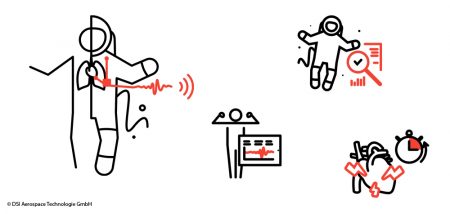
Astronauts are subject to a high level of physical stress in weightlessness. The continuous monitoring of important bodily functions, especially of the cardiovascular system, is therefore urgently required during the stay in space. Findings from space medicine can also be applied to the diagnosis of heart diseases, which are the most common cause of death worldwide. According to the German Federal Statistical Office, the cost of cardiovascular diseases in 2015 amounted to EUR 46.4 billion. Systems currently used for cardiac diagnostics offer only limited possibilities for monitoring high-risk patients or can only be used for inpatient treatment. The “Dr. Beat” project relies on ballistocardiography (BCG), originally developed for space, which can record actual heart function using modern, digital microelectronics. Within the scope of the project, a high-precision and cost-effective BCG sensor system is being developed that can be worn on the body as a “wearable” and enables continuous health monitoring. The extensive signal processing, data evaluation and diagnostics will be automated by means of Artificial Intelligence (AI) and should not only provide new insights into space medicine but also improve diagnostics and early detection of cardiological diseases in everyday life.
Benefits:
Cost-effective, wearable BCG sensor system including signal processing and data evaluation for diagnostics and prediction of cardiovascular processes
Comprehensive, ubiquitous, discrete and continuous cardiovascular diagnostics for risk patients on Earth and astronauts in space using AI
Fields of application: space medicine, terrestrial medical technology, wellness sector, safety-critical jobs (e.g. pilots, drivers)
QuMSeC – Quantum Memories for Secure Communication
With a turnover of USD 156.3 billion1, satellite communication is a key component of the global digital economy and is of strategic importance to government and society. The Internet, television, telephony or communication in aviation and shipping rely on highly secure satellite communication networks. However, the encryption methods used in data transmission today are vulnerable, which poses considerable security risks for critical infrastructures in the energy, telecommunications and transport sectors, for example. Quantum communication generally provides the necessary cyber security for current and future satellite communication systems. However, this has so far been based on the assumption of complete control over the development, manufacture, launch and operation of satellites. The „QuMSeC“ project, carried out by Humboldt-Universität zu Berlin and Technische Universität Berlin, is intended to set new standards for secure quantum key exchange with the help of quantum storage devices, even for untrustworthy satellites. In the future, customers and users without their own satellite infrastructure should benefit from secure data communication via satellites.
1 Global Space Economy 2018 (Source: Bryce Space and Technology, 2020)
Benefits:
Verifiable communication security
Market basis for quantum communication providers
Enables economic exploitation of quantum communication
Strengthening of the German leadership role in quantum technology
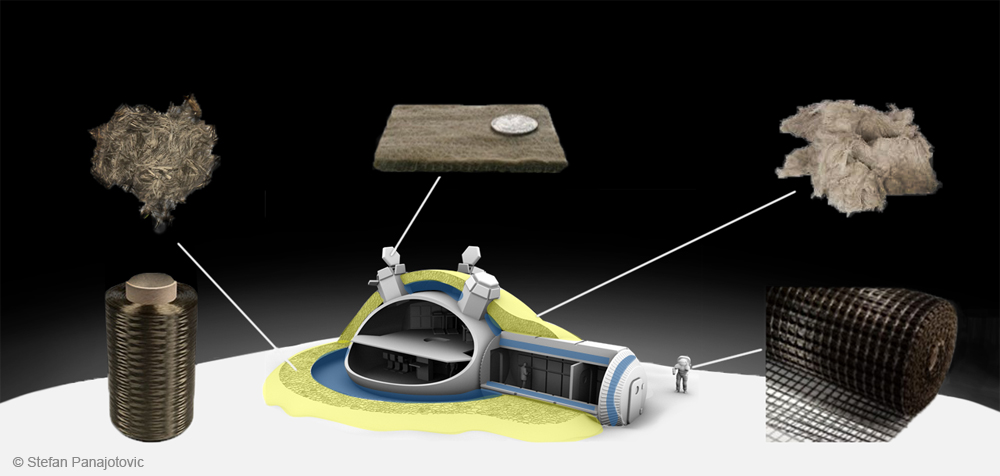
MoonFibre – Spinning Technology Fibres from Lunar Rock for Direct Use on Earth’s Satellite
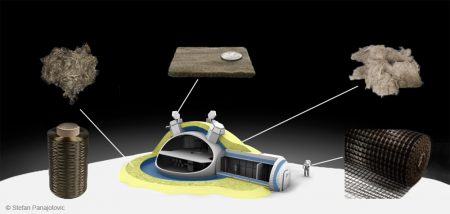
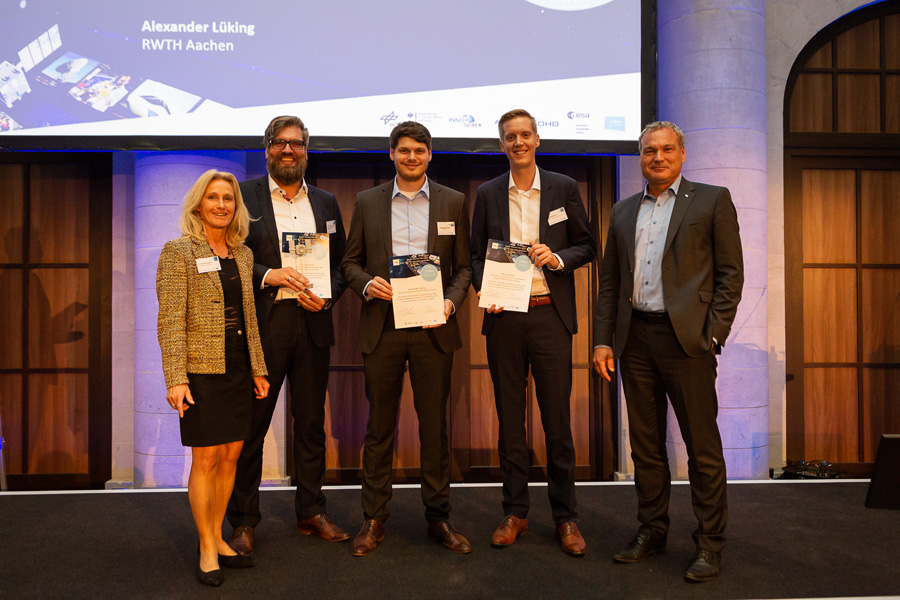
Private and public institutions all over the world pursue one common mission: a manned station on the moon. The costs of rocket flights alone to transport such a station to the moon would be approximately EUR 1,000,000 per kilogramme. This is why numerous research teams around the world are working on solutions to use moon rock to manufacture 3D-printed structural components on-site. The MoonFibre project at RWTH Aachen University is developing a spinning system that will be able to produce fibres directly from lunar rocks. These fibres could be used not only to stabilise the 3D-printed structure of the lunar station, but also for thermal isolation, filter systems, or the textiles of astronaut suits. RWTH Aachen intends to further develop a spinning process already used in industry for basalt fibres as a compact and easily transportable system for use on the lunar surface. The spinning process is to be tested under zero gravity within an in-orbit demonstration experiment. The proof-of-concept will serve as the basis for the future on-site production of fibres and textiles on the moon.
Benefits:
Permanent settlements on the moon and technology transfer into space
Cost-effective on-site production of fibres and textiles on the lunar surface
Development of a robust, automated, and miniaturised spinning technology
STMF – Satellite Thermal Management with Ferrofluids
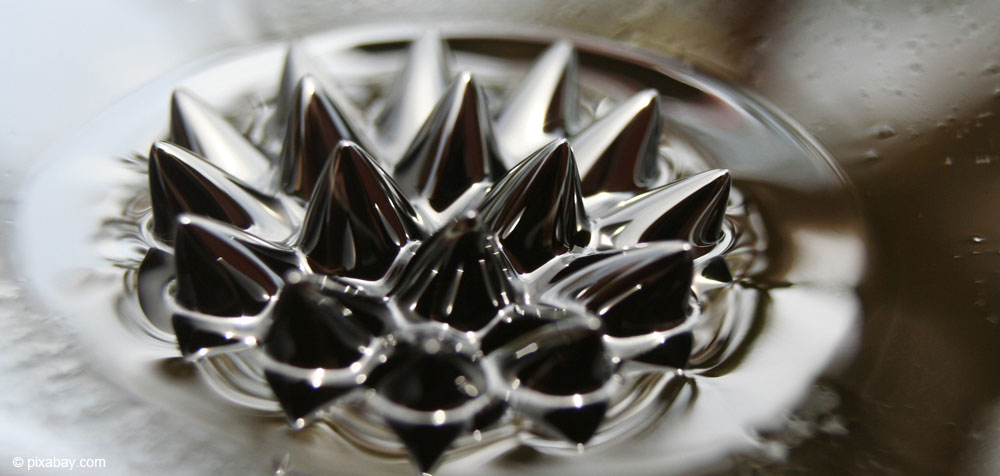
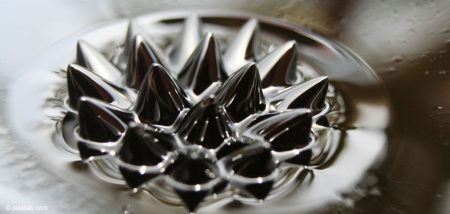
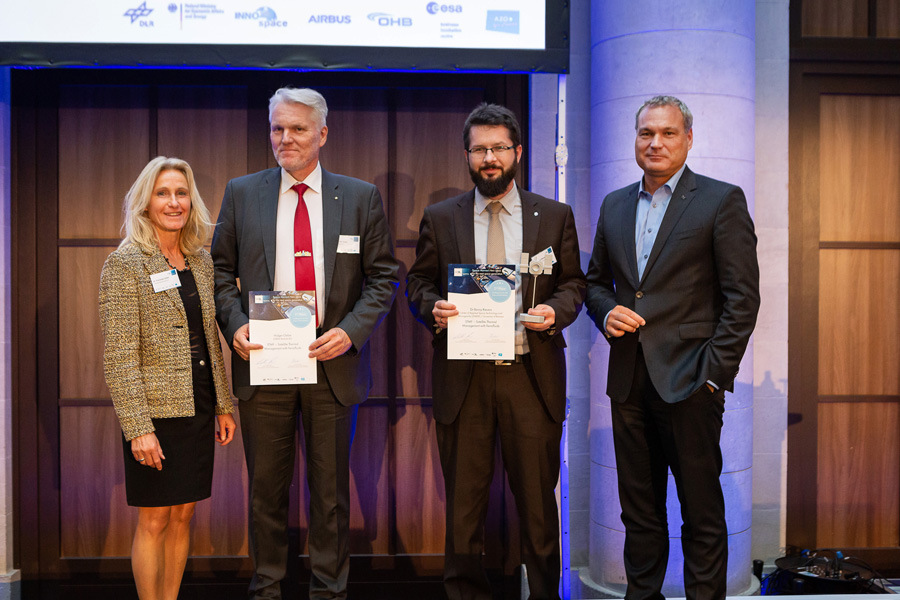
The thermal control system (TCS) is a critical component of satellites, one that is supposed to regulate the temperature of payloads and satellite buses under varying internal and external heat loads. Conventional TCSes use cooling fluids and mechanical pumps whose vibrations disturb payloads and sensors onboard a satellite. ZARM proposes a TCS technology based on ferrofluid cooling liquid that is pumped by magnetic fields to avoid mechanical vibrations. This TCS consists of pumping modules that are constructed from a minimum of four magnetic coils to transfer the ferrofluid. To avoid magnetic disturbances in other parts of the satellite, a μ-metal shield is placed around the pump. Since ferrofluids take on different magnetic properties when cooled or heated, permanent magnets can be employed to define prominent places where heat is absorbed. The focus lies on a scalable and modular design that can be included in a broad range of satellite missions. In particular, such missions will likely involve concepts with strongly varying thermal boundary conditions and high-precision measurements, such as for geodesy, Earth observation, or fundamental physics applications.
Benefits:
Decreased vibrations within the thermal control system
Improved noise environment
Scalable, flexible, modular design that can be adapted to a broad range of thermal boundary conditions
SmartSpace – A Module for Global IoT Cloud Service Operations
Existing cellular network infrastructure is not sufficient for the widespread use of Internet of Things (IoT) applications outside metropolitan areas. A functional data connection forms part of the core of any IoT application. Currently, transmitting data to IoT devices via satellites is uneconomical and complex because the devices are designed with a small form factor (i.e. small antennas), which facilitates low-power consumption and minimal data throughput. The SmartSpace concept provides for dedicated communication modules on the ground and in the space segment to enable data collection and transmission. Within this concept, SmartSpace modules serve as a data collector for multiple IoT devices and their applications and relay the collected data via a superior satellite backbone network. It is no longer necessary to operate a dedicated ground station, the intermediate SmartSpace network acts as a connecting link. This will facilitate the use of SmartSpace in remote areas and large infrastructures.
Benefits:
Enable terrestrial and space-borne IoT applications
Cloud-based monitoring and control for satellites
Big data analytics for small satellite missions and turnkey CubeSat operations
Terrestrial SmartSpace network to grow incrementally via new module launches
Flow Front Detection with Fibre-Optic Sensors in the Rotating Infusion
Process for CFRP (carbon-Rber-reinforced polymer) Components
In the boosters of the Ariane-6 launch vehicle MT Aerospace AG of Augsburg, Germany, is producing some of the space industry’s largest CFRP components. Measuring around 12 metres long and 3.4 metres in diameter, these parts are manufactured using a vacuum infusion process in which dry carbon fibres are wound around a form and then submerged in resin. Intelligent sensors are needed to monitor the flow front of the resin as it is introduced and optimise the overall process. For this purpose, MT Aerospace AG is now working with Fraunhofer LBF on incorporating glass fibre sensors into its components during the winding phase. During infusion, each component has to be turned slowly in an oven. This delicate step is where the sensors monitor the distribution of the resin.
Benefits:
Digitalised manufacturing optimises the process while reducing costs
Visualisation of previously hidden processes and corresponding digital controls provide for increased process stability
Information gained from sensors makes it possible to automate the Aow of resin and ensure quality and repeatability
Process data also improves control and accelerates ramp-up to serial production, which makes the company more competitive
Fraunhofer LBF Darmstadt, Germony Martin Lehmann www.lbf.fraunhofer.de martin.lehmann@lbf.fraunhofer.de