Additive manufacturing method for metallic coatings of CFRP propellant tanks
Propellant tanks for rocket stages made of carbon-fibre reinforced plastics (CFRP) need to be lined with a metallic coating (called a liner) on the inside to protect the material from aggressive propellant components and to ensure tightness. Until now, these protective layers have been produced in an expensive manufacturing process by forming and welding thin-walled metal sheets. Additive Space GmbH is developing a thermal spraying process by which metallic coatings can be applied to the inside of the CFRP structure quickly and cost-effectively. The method enables several layers of metals with different material properties to be applied one after the other with the minimum required layer thickness. Apart from the spraying device, which is mounted on an industrial robot, for example, no further devices adapted to the geometry of the respective fuel tank are required.
Benefits:
Thermal spray process for very thin coating thicknesses (≤ 100μ) with low mass increase
Cost / effort reduction, since a metal liner does not have to be produced separately
No geometric specific devices necessary – universal system use
Moderate development risk through adaptation of an established procedure
QuMSeC – Quantum Memories for Secure Communication
With a turnover of USD 156.3 billion1, satellite communication is a key component of the global digital economy and is of strategic importance to government and society. The Internet, television, telephony or communication in aviation and shipping rely on highly secure satellite communication networks. However, the encryption methods used in data transmission today are vulnerable, which poses considerable security risks for critical infrastructures in the energy, telecommunications and transport sectors, for example. Quantum communication generally provides the necessary cyber security for current and future satellite communication systems. However, this has so far been based on the assumption of complete control over the development, manufacture, launch and operation of satellites. The „QuMSeC“ project, carried out by Humboldt-Universität zu Berlin and Technische Universität Berlin, is intended to set new standards for secure quantum key exchange with the help of quantum storage devices, even for untrustworthy satellites. In the future, customers and users without their own satellite infrastructure should benefit from secure data communication via satellites.
1 Global Space Economy 2018 (Source: Bryce Space and Technology, 2020)
Benefits:
Verifiable communication security
Market basis for quantum communication providers
Enables economic exploitation of quantum communication
Strengthening of the German leadership role in quantum technology
PCM-Polymer Compound – Novel Material for Thermal Stabilisation of Component Systems
Spacecraft components are constantly subjected to thermal variations. To avoid overheating or undercooling of these components, ESDA-Axiotherm GmbH is developing a phase-change material (PCM) polymer compound for the thermal stabilisation of space components and systems. The PCM polymer compound features a high capacity for absorbing accumulating amounts of heat and releases the heat energy into the system during an undercooling period in order to stabilise the temperature. This material will prevent temperature peaks and produce a smoothed temperature curve. Its unique feature is a mix of materials that remains gelatinous when melted. The compound is leak-proof and well-suited to processing. Furthermore, it is possible to use additives to make permanent, stable modifications to properties such as thermal conductivity, fire protection, and radiation resistance. In particular, batteries (and by extension, the field of e-mobility) should benefit from this life-prolonging technology.
Benefits:
Effective smoothing of temperature peaks and reduced thermo-mechanical stress
Increased useful life of batteries and electronic components, plus increased operational safety
Low mass, high capacity & directly applicable to all battery sectors (automotive/maritime/aviation)
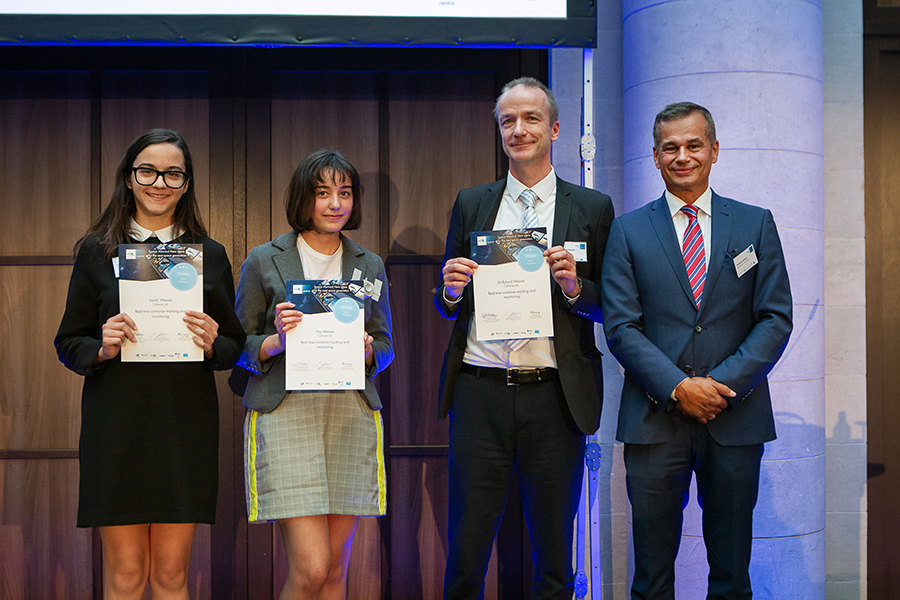
Modern transport and logistics require real-time tracking and monitoring of shipping containers worldwide. Many applications on the market track only the location of the vessel on which a container is transported – not the container itself. Therefore, the tracking signal is lost when the container is transferred between ships, trains, trucks and aircraft, or if it happens to be lost at sea. Callwise Ltd. addresses these issues using an innovative combination of satellite communication and a 5G LoRaWAN (Low Range Wide Area Network) IoT solution. This solution enables real-time tracking and monitoring of individual shipping containers from start to finish during multimodal transport. The concept is based on a novel architecture in which satellite and cellular tracking is combined with LoRaWAN tracking and monitoring of individual shipping containers. Callwise Ltd. is targeting logistics and shipping companies that can offer this end-to-end solution to customers as a value-added service in their product portfolios. Furthermore, the system is able to generate alerts for a wide range of events (unauthorised door opening, deviation from a predefined route, changes in container temperature, etc.) and also track down containers lost at sea.
Benefits:
Real-time location information on shipping containers from start to finish
Ability to monitor several parameters inside containers (e.g. temperature, air pressure, air moisture)
Deployables Cubed – Actuator for Nanosatellite Applications
The aerospace sector is trending towards small, standardised satellites (CubeSats) that offer affordable access to space. Their standard edge length of 10 cm does present a disadvantage, however, as it significantly limits the missions these satellites can support. To get around these limitations, deployable structures like antennas or sails are being used, that are deployed once a satellite is in orbit. This opens the door to high-performance applications that are typically only possible with large satellites. Initiating this deployment requires special actuators such as hold-down and release mechanisms. Unfortunately, European actuators are too large for this purpose, and American products are subject to export restrictions. To solve this problem Deployables Cubed – a new space company at ESA BIC Bavaria – is developing pin-puller and release nut actuators to ensure Europe’s independence with regard to these small actuators and the deployable structures that they make possible. The company plans to establish for simple, light, and reliable aerospace actuators on the market and offer them to a broad range of customers.
Benefits:
Nanosize actuator (optimised for cubesat applications)
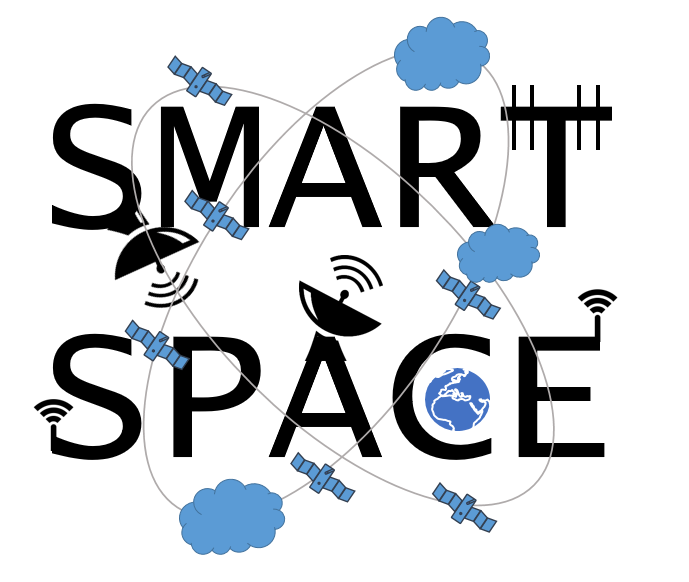
SmartSpace – A Module for Global IoT Cloud Service Operations
Existing cellular network infrastructure is not sufficient for the widespread use of Internet of Things (IoT) applications outside metropolitan areas. A functional data connection forms part of the core of any IoT application. Currently, transmitting data to IoT devices via satellites is uneconomical and complex because the devices are designed with a small form factor (i.e. small antennas), which facilitates low-power consumption and minimal data throughput. The SmartSpace concept provides for dedicated communication modules on the ground and in the space segment to enable data collection and transmission. Within this concept, SmartSpace modules serve as a data collector for multiple IoT devices and their applications and relay the collected data via a superior satellite backbone network. It is no longer necessary to operate a dedicated ground station, the intermediate SmartSpace network acts as a connecting link. This will facilitate the use of SmartSpace in remote areas and large infrastructures.
Benefits:
Enable terrestrial and space-borne IoT applications
Cloud-based monitoring and control for satellites
Big data analytics for small satellite missions and turnkey CubeSat operations
Terrestrial SmartSpace network to grow incrementally via new module launches
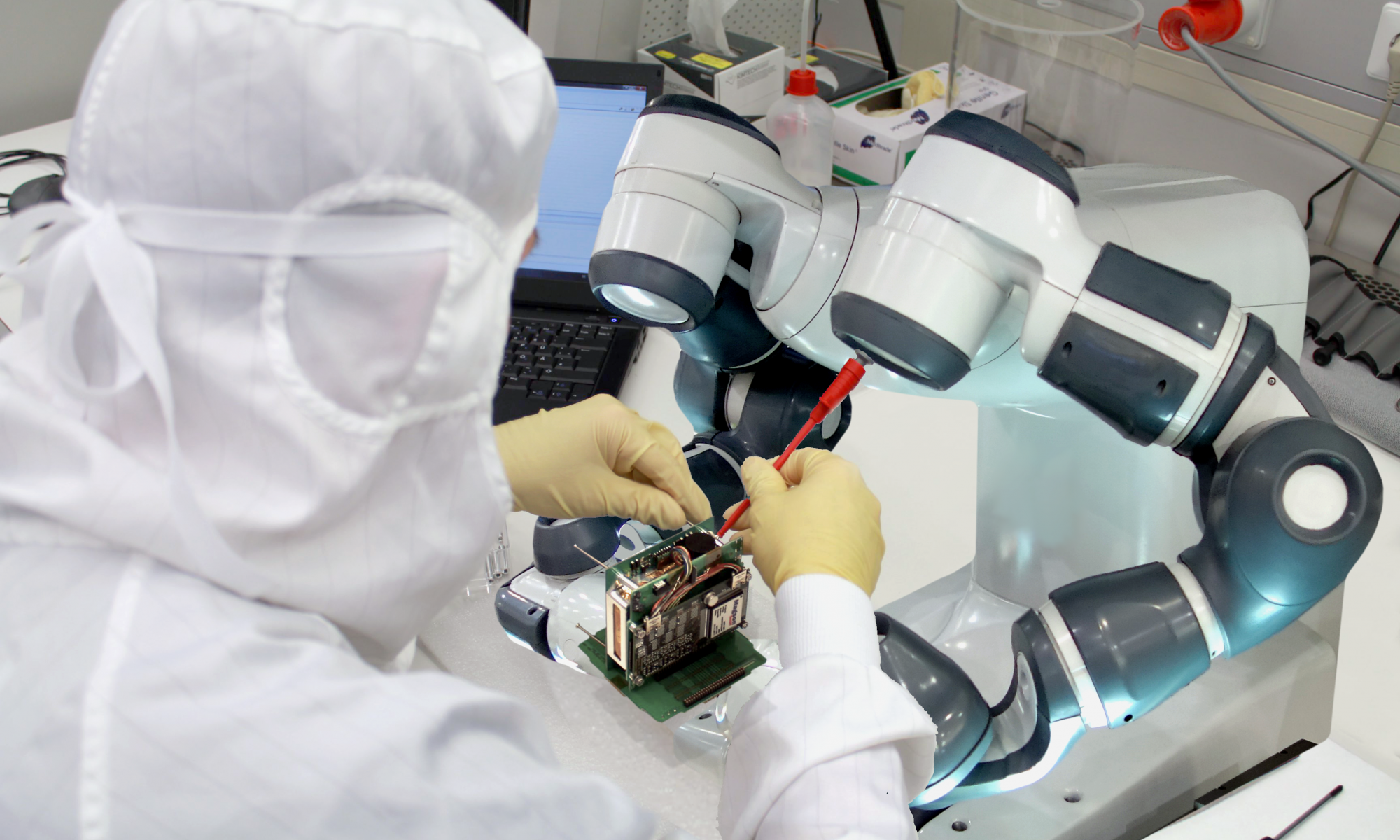
MSP: Advanced Modular Production of Microsatellites
To keep up with the emerging requirements of mass production, mega-constellations and formations of microsatellites one needs innovative lest concepts and production processes. Modern manufacturing techniques from the realm of lndustry 4.0 can open the door to significant productivity gains in high-volume satellite production. The Zentrum für Telematik e.V. (Würzburg) is working on transferring new methods and tools for satellite production into the space sector. The submitted idea is specifically geared towards humanrobot collaboration based on the use of a lightweight robot.
Benefits:
Integrated testing and production systems increase lot sizes and quality
Modularisation and standardisation in electronic production reduces overall system complexity, which also simplifies the production process
Testing based on smart components reduces production costs
Zentrum für Telematik (ZfT) Würzburg, Germany Prof Dr Klaus Schilling www.telematik-zentrum.de info@telemotik-zentrum.de
Wall#E: Fibre-Reinforced Spacecraft Walls for Storing Energy
The idea behind Wall#E involves integrating energy storage functions into the support structures of spacecraft, which will significantly reduce the mass and volume of satellites without sacrificing performance. To this end, Wall#E utilises fibre-reinforced structures (which enjoy more and more popularity in aerospace engineering) infiltrated with innovative solid-state battery materials. While this project’s initial focus is on satellites, the underlying concept can easily be adapted to launch systems, space stations, and ground-based e-mobility applications.
Benefits:
Reduced satellite mass
Simpler, more compact constructions
Lower costs of development/launch
TU Braunschweig – Institute of Space Systems Brunswick, Germany Prof Dr-Ing Enrico Stoll www.space-systems.eu e.stoll@tu-bs.de
Biocontroller – Platform Technology for the Improvement of Microbes Applied in Space Missions
Microbes are a ticking time bomb for long-term space missions. Microbes evolve thousands of times faster than humans and, in space, they are no longer kept in check by the inexhaustible diversity of the Earth’s biosphere. Regulating the evolution of microbes is crucial to prevent microbes from evolving in undesired directions and becoming tremendous threats to human health. The OPE Group’s expertise lies in controlling the evolution of microbes. For this purpose, OPE designed innovative bioreactors and developed IoT-enabled hardware and software to train microbes to be beneficial to space travellers. The technology allows in-situ resource utilization and resource recovery during deep space missions.
Benefits:
Cost-effective support of human life on spacecraft
In-situ resource utilisation and resource recovery during deep space missions to produce clean water, food, fuel, soil fertilisers, chemicals, medicines and a large variety of other materials
Stable and robust foundation for new ecosystems on celestial bodies to foster population
Reinforcing the space travellers’ microbiome for disease prevention and well-being
Modern satellites, especially micro and nano satellites, have little in-orbit processing capabilities and data storage capacities. The satellites are dependent on sending their data regularly to a ground station. Golbriak Space OÜ is developing a cloud computing infrastructure on the International Space Station (ISS) using the Bartolomeo platform, to serve other spacecraft that would not be able to afford on-orbit processing otherwise. The “Bartolomeo cloud” could be realised through a compact high-performance computing data centre installed on the ISS, interfaced to customer spacecraft through an optical and a radio frequency (RF) antenna terminal installed on the ISS. Potential ISS cloud services could reduce the time between data acquisition and availability, in order to introduce new capabilities such as automated feature detector for Earth observing spacecraft, enhanced spacecraft autonomy (cognitive satellites) and real-time machine learning on space data.
Benefits:
Reduction in time between data acquisition and availability
In-orbit spacecraft have the ability to use machine learning services
Opportunity to extend missions
Complementary services e.g. data storage and high-bandwidth data downlink