SPACE IC produces highly integrated and versatile microchips for efficient power conversion. In satellite payloads, these chips help solve the power interface problem which electronic modules face. Individual power interfaces limit the reusability of these modules and make power distribution systems both complicated and inflexible. This is where the Standard lntermediate Power Bus Interface comes into play, which SPACE IC is going to define along with experts in power management. A standard interface of this kind will aid satellite payload manufacturers in increasing efficiency and Aexibility of power distribution while reducing complexity and costs.
Benefits:
Flexible, efficient power distribution
Simplified development and production
lmproved reusability and risk reduction
Multiple cost-reduction effects, from reduced weight and effort to mass production
SPACE IC GmbH Hanover, Germany Volodymyr Burkhay www.space-ic.com info@space-ic.com
MSP: Advanced Modular Production of Microsatellites
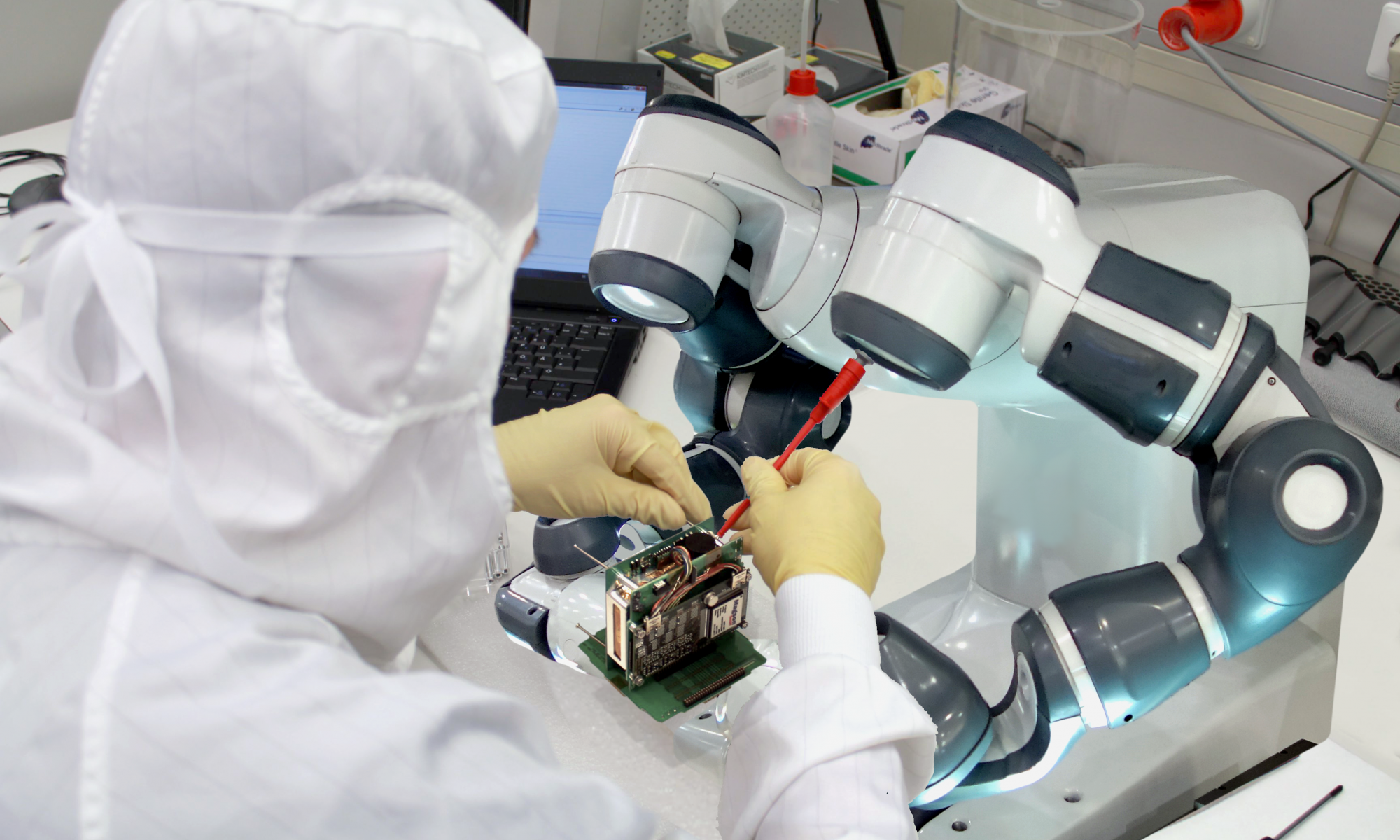
To keep up with the emerging requirements of mass production, mega-constellations and formations of microsatellites one needs innovative lest concepts and production processes. Modern manufacturing techniques from the realm of lndustry 4.0 can open the door to significant productivity gains in high-volume satellite production. The Zentrum für Telematik e.V. (Würzburg) is working on transferring new methods and tools for satellite production into the space sector. The submitted idea is specifically geared towards humanrobot collaboration based on the use of a lightweight robot.
Benefits:
Integrated testing and production systems increase lot sizes and quality
Modularisation and standardisation in electronic production reduces overall system complexity, which also simplifies the production process
Testing based on smart components reduces production costs
Zentrum für Telematik (ZfT) Würzburg, Germany Prof Dr Klaus Schilling www.telematik-zentrum.de info@telemotik-zentrum.de
Flow Front Detection with Fibre-Optic Sensors in the Rotating Infusion
Process for CFRP (carbon-Rber-reinforced polymer) Components
In the boosters of the Ariane-6 launch vehicle MT Aerospace AG of Augsburg, Germany, is producing some of the space industry’s largest CFRP components. Measuring around 12 metres long and 3.4 metres in diameter, these parts are manufactured using a vacuum infusion process in which dry carbon fibres are wound around a form and then submerged in resin. Intelligent sensors are needed to monitor the flow front of the resin as it is introduced and optimise the overall process. For this purpose, MT Aerospace AG is now working with Fraunhofer LBF on incorporating glass fibre sensors into its components during the winding phase. During infusion, each component has to be turned slowly in an oven. This delicate step is where the sensors monitor the distribution of the resin.
Benefits:
Digitalised manufacturing optimises the process while reducing costs
Visualisation of previously hidden processes and corresponding digital controls provide for increased process stability
Information gained from sensors makes it possible to automate the Aow of resin and ensure quality and repeatability
Process data also improves control and accelerates ramp-up to serial production, which makes the company more competitive
Fraunhofer LBF Darmstadt, Germony Martin Lehmann www.lbf.fraunhofer.de martin.lehmann@lbf.fraunhofer.de
Additive Manufacturing for Space Using High-Performance
Polymers
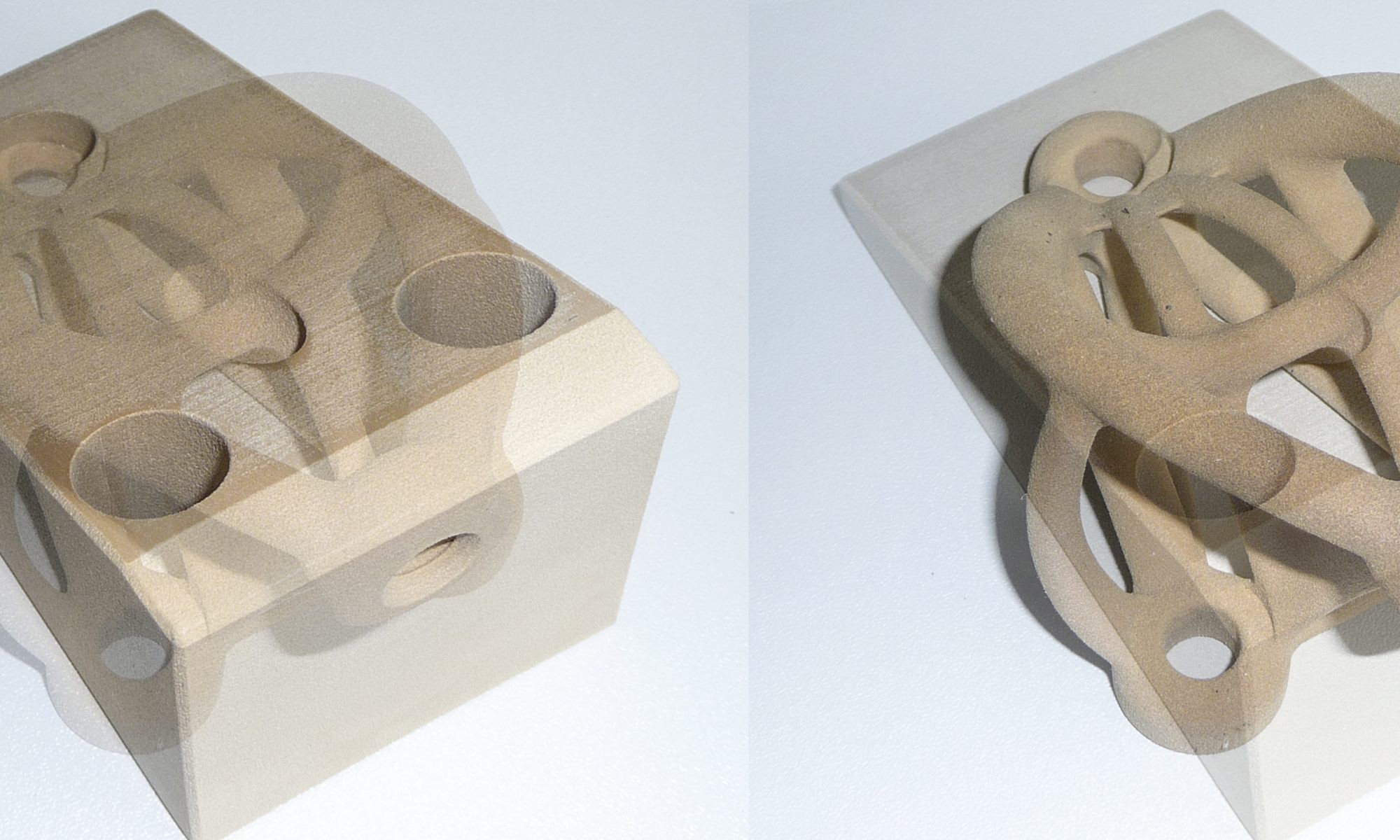
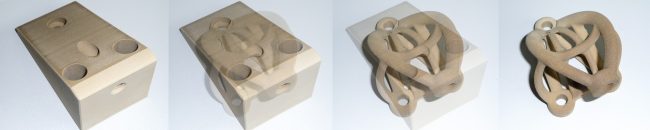
AMPFORS (Additive Manufacturing of Polymer Parts for Space) is seeking to replace the metal structural components used for space applications with lightweight polymer parts. These parts are produced by means of additive manufacturing, which is also known as 3 D printing. To compensate for their lower mechanical stability compared to meta 1, the polymer components are then outfoted with a metallic layer to form a “sandwich” composite. AMPFORS plans to use both the high-performance polymer PEEK and the less expensive material polyamide (PA). In addition to the space sector, this project’s key markets include aircraft manufacturing, mechanical engineering, tool-making, and medical equipment production.
Benefits:
Makes satellite structures up to 20% lighter and up to 50% less expensive
lncorporation of metal coatings improve the mechanical, electrical, and thermal properties of polymers; also prevents the emission of water and monomers
Additive Manufacturing process speeds up component design and production
Fraunhofer IST Brunswick, Germany Dr Andreas Dietz www.ist.fraunhofer.de ondreos.dietz@ist.frounhofer.de
Wall#E: Fibre-Reinforced Spacecraft Walls for Storing Energy
The idea behind Wall#E involves integrating energy storage functions into the support structures of spacecraft, which will significantly reduce the mass and volume of satellites without sacrificing performance. To this end, Wall#E utilises fibre-reinforced structures (which enjoy more and more popularity in aerospace engineering) infiltrated with innovative solid-state battery materials. While this project’s initial focus is on satellites, the underlying concept can easily be adapted to launch systems, space stations, and ground-based e-mobility applications.
Benefits:
Reduced satellite mass
Simpler, more compact constructions
Lower costs of development/launch
TU Braunschweig – Institute of Space Systems Brunswick, Germany Prof Dr-Ing Enrico Stoll www.space-systems.eu e.stoll@tu-bs.de
SPUTNIC-Piezo: Spacewheel Unbalance TerminatioN with Intelligent Control of Piezoactuators
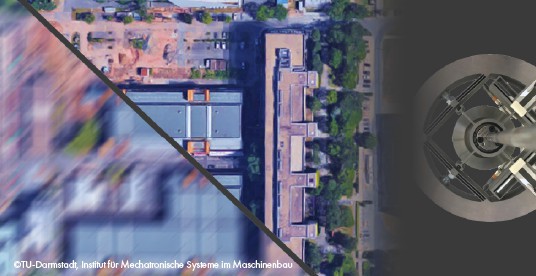
Manufacturing tolerances and the related imbalances in reaction wheels lead to vibrations in satellite structures. These vibrations are detrimental to the performance of sensitive payloads such as telescopes and cameras, which can produce poor image quality as a result (see illustration). SPUTNIC technology combines piezoelectric actuators with conventional ball-bearings to support rotating wheels. Since the unbalanced wheel is allowed to spin on its main axis of inertia, SPUTN IC’s sophisticated control algorithm nearly eliminates all imbalance vibrations. This innovation not only reduces the stress on components to increase their useful life; it also enables sensitive payloads to reach their full potential.
Benefits:
Eliminates vibrations in reaction wheels
Enables sensitive payloads to achieve optimal performance
Simple, lightweight structure with low energy consumption
Failsafe design enables reaction wheels to remain functional even when system is inactive
TU Darmstadt – Institute lor Mechatronlc Systems in Mechanical Engineering (IMS) Darmstadt, Germany Stefan Heindel www.ims.tu-darmstadt.de info@ims.tu-darmstadt.de
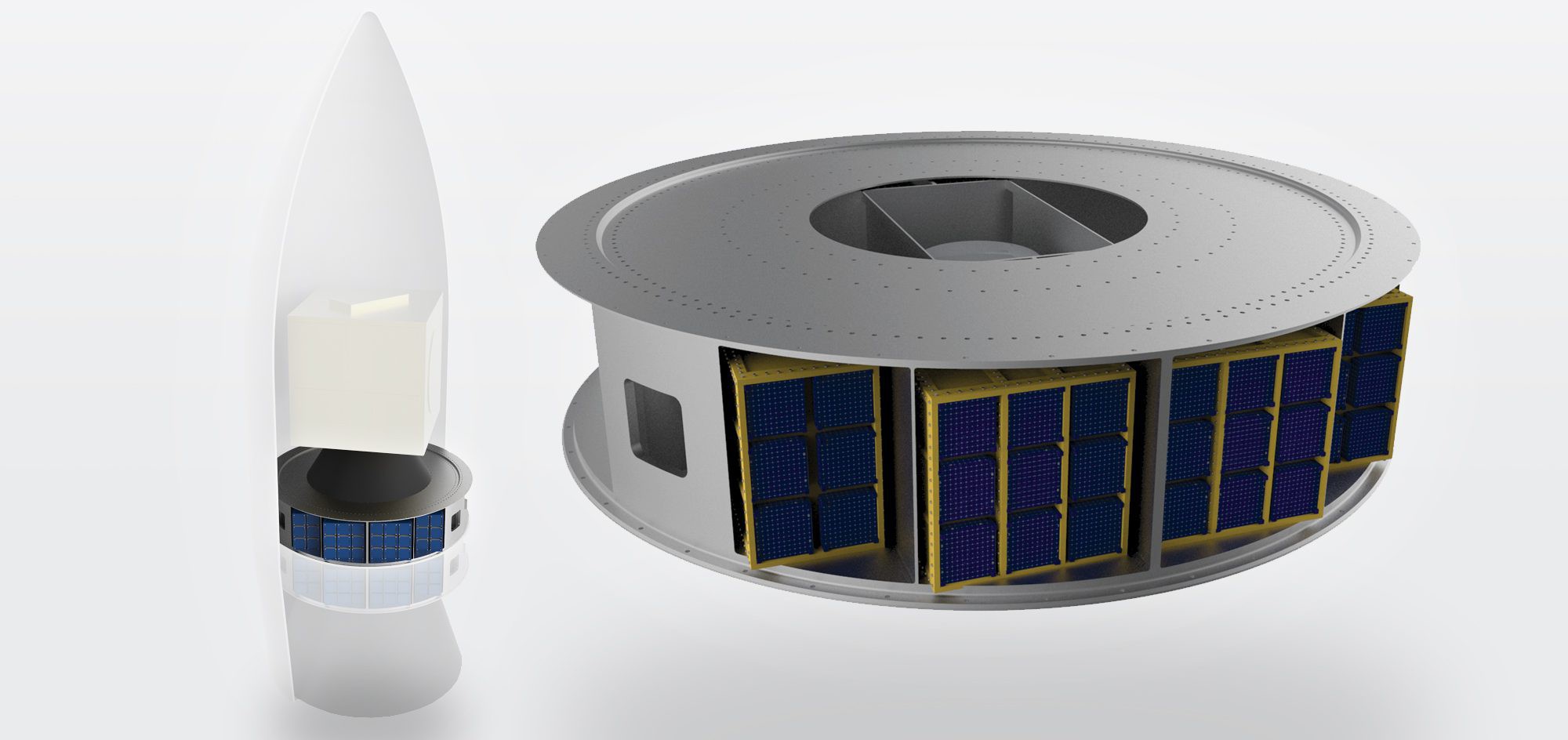
In the next decade, Europe will need a replacement for the International Space Station (ISS) – a new environment in which payloads can be tested in microgravity and the extreme conditions of space. Levity Space System has set its sights on providing public and private institutions with frequent, affordable access to space. MESA – Europe’s first modular and stackable satellite structure – is designed to facilitate microsatellite launches, in-orbit demonstrations, and the hosting of experiments. lt will be launched as a secondary payload between the upper stage and primary payload of the Arianespace launch vehicles VEGA-C+ and -E.
Benefits:
Flexible, modular structures for space transports
Sustainable R&D in space in the post-ISS era
Turnkey launch solutions and microsatellite deployment in constellations
MESA subsystems capable of transporting technologies and experiments directly from labs into space
Levity Space Systems Aachen, Germany Andres Lüdeke www.levity.space andres.luedeke@levity.space
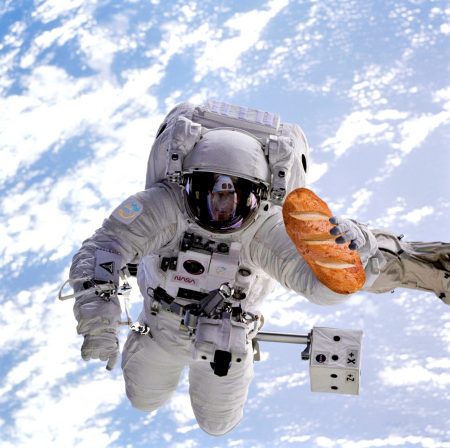
The objective of Bake in Space is to make fresh bread – in this case, common German rolls – aboard the International Space Station (ISS). To that end, the project is building a space-ready oven that will be capable of baking a dough mixture designed for this unique weightless environment. The idea is to use this endeavour as a stepping-stone to providing fresh food that will benefit the wellbeing and general quality of life of those living and working in space. Bake in Space is leveraging the business opportunities afforded by the commercialisation of the ISS and is contributing directly to NASA and ESA’s goals for the long-term exploration efforts of humankind.
Benefits:
Bulk dough packages for future astronaut missions (also suitable as unique gifts for people on Earth)
Branded products for space conferences and other events
Oven will be made available on a pay-per-use basis to other researchers interested in exploring its uses on the ISS
Project will generate spin-off IP and products that could be used for B2B and B2C activities on Earth
Bake in Space GmbH Bremen, Germany Sebastian D. Marcu www.bakein.space sebastian@bakein.space